Terence is a Research Coordinator for the Foundation of HKPLTW with interests in history & traditions, social organization & inter-group relations, culture & religion, and economics & politics of Canadian Indigenous People and Visible Minorities. Follow him on Twitter: @hkpltw
Poverty can affect the strength and resiliency of our communities. Economic growth can slow and even decline when the middle-class struggles, income inequality rises, and poverty persists.
Having considered this article series and the questions posed within it, our NGO (HKPLTW) invites you to participate in the discussion of the development of a comprehensive poverty reduction strategy that will guide its actions in the future of Canada.
Increase Awareness of Poverty
To increase awareness of poverty in Canada, it is better to create a simulation campaign that allows all Canadians to experience the choices and lack of choices faced by those living in poverty. Once there, you can choose to simulate the life of a single person, single-parent family, or two-parent family living at or below the poverty line. You will be given a monthly budget and make choices while you live paycheque-to-paycheque and try to make the month. The simulation not only allows you to experience what it’s like to face these choices, but also gives people the opportunity to get involved by sharing their experience, learning more about poverty and donating towards programs that directly support Canadians to move out of poverty. While it is an excellent idea on paper, it may be hard to advise the simulation to the public. Here is where we need to be original.
Embrace Social Media
The emergence of social media has revolutionized marketing and public relations for original ideas, providing a platform for organizations to quickly and easily share their story. In our case, I believe that we can make the simulation into a monthly campaign that allows people to experience the difficulty faced by those living in poverty. Given the criteria and goals set by our “simulation” idea, I put the target audience as Canadians who are “Somewhat” aware of poverty being a major social issue in a First World nation like Canada. To reach the audience, I have two objectives for this campaign. First, the campaign aims to increase the number of donors to invest in non-profit’s programs to help those living in poverty. Second, it seeks to raise awareness of poverty among the target audience (Canadians), influencing public acceptance of the poverty problem and increasing public skepticism of the government’s poverty reduction policy.
Be Original to Increase Awareness
My tactic for the campaign focuses on social media because it is an effective method to attract a large audience. My goal for this campaign aims to achieve long-term, lasting behavioural changes in the target audiences. Therefore, awareness of this campaign must address our purposes and increase the target audience’s enthusiasm and support. Based on my outline, I think that the poverty simulation can be a live-streaming marathon on social media instead of a fundraiser event.
My idea is that we invite a group of random Canadians to experience a day of living below the poverty line, live stream their experiences, and share real-life videos on social media platforms. For example, there would be a Livestream daily throughout October. Seeing the struggles and the lack of choices faced by those on Livestream, the audience would realize that poverty is a social problem that consistently affects the lives of many Canadians.
It can deepen the emotional connection with the target audience, creating and delivering results that matter. Also, the Livestream helps to advertise the campaign without spending a large sum of money. I believe that a live-streaming marathon throughout October can break the mould, encouraging a diverse group of Canadians to understand the impact of poverty and take action to support and donate to the nonprofit program that helps those living in poverty.
Personal responsibility and entitlement will increase awareness
I believe that the live-streaming marathon informs Canadians about poverty in our society and initiates more Pro-Active dialogues about poverty reduction. Overall, my tactic is to address and reduce the skepticism of Canadians about poverty in a First-World country like Canada by showing them the struggles faced by those living paycheque-to-paycheque through Livestream on social media.
Through witnessing the struggles on their phones, the campaign can convince some target audience (Canadians) that individual actions and donations are worthwhile and can lead to immense contributions to reducing poverty. Eventually, the target audience’s new sense of personal responsibility and entitlement will increase awareness, as more Canadians will support and donate to the non-profit organizations and their program to help people escape poverty.
Terence is a Research Coordinator for the Foundation of HKPLTW with interests in history & traditions, social organization & inter-group relations, culture & religion, and economics & politics of Canadian Indigenous People and Visible Minorities. Follow him on Twitter: @hkpltw
Poverty can affect the strength and resiliency of our communities. Economic growth can slow and even decline when the middle-class struggles, income inequality rises, and poverty persists.
Having considered this article series and the questions posed within it, our NGO (HKPLTW) invites you to participate in the discussion of the development of a comprehensive poverty reduction strategy that will guide its actions in the future of Canada.
Some Canadians Are At Higher Risk of Poverty
Poverty places a heavy burden on individuals. Canadians living in poverty are forced to make difficult choices, often deciding between paying for necessities such as rent and utilities or buying healthy food, clothing and medication. Deprivation can also cause people to make dangerous choices, like staying with an abusive partner rather than risking their children living in poverty. In addition, certain groups are more likely to live in low income than others. These groups include women, persons with disabilities, newcomers to Canada, single parents, unattached individuals, Indigenous peoples, trans-gendered and non-binary individuals, and individuals from radicalized communities. To them, poverty entails more than the lack of income and productive resources to ensure sustainable livelihoods. Its manifestations include hunger and malnutrition, limited access to education and other essential services, social discrimination and exclusion, and the lack of participation in decision-making. In addition, these groups bear a disproportionate burden of poverty.
Therefore, the poverty reduction policy in Canada is a long-term goal requiring commitment and accountability from the government and non-governmental organizations to address the root causes of poverty, provide for basic needs for all and ensure that the poor have access to productive resources, including credit, education and training.
Poverty and Its Impact on Women
Women have been more likely to live in poverty than men, although, in 2016, the overall percentage of men (10.3%) and women (10.8%) in poverty was about the same. However, across Canada, some women face unique barriers that make them more vulnerable to poverty than men. For instance, 80% of single parents are women. As a result, over one-third of single-parent women live in poverty. In addition, women tend to take on more responsibilities and put more hours into caregiving activities than men, which becomes much more stressful if they also struggle to make ends meet.
Therefore, it is crucial to address poverty among women because of the added impact of poverty on their children. Some individuals may also face intersecting challenges that make them more at risk of poverty, for example, individuals from radicalized communities and transgender individuals. In addition to being more likely to experience low income, these groups are statistically more likely to live in low pay for long periods. This is troubling because the longer a person is poor, the harder it is for them to escape poverty.
Poverty’s Impact on Remote Area Residents
Furthermore, individuals living in remote communities can also experience distinct challenges that make them more at risk of living in poverty, such as increased costs of food, barriers to accessing health care and unmet housing needs, which are challenges in Nunavut.
Impact of Poverty on Newcomers to Canada
Another high-risk group is newcomers to Canada. We, as Canadians, need to acknowledge that racism can profoundly impact the hiring practices of businesses and agencies throughout the city. Lower the employment gap between visible and non-visible minorities. For example, in 2016, the total number of immigrants, including non-permanent residents within Calgary, was 431,870. According to Census 2016 data, 17% of the people who immigrated to Calgary are living in low income. In comparison, the same data source shows that 7.6% of non-immigrants were living in low income.
On a community level, unique challenges persist for newly arrived individuals and families as they become woven into the social fabric of Canada. Some systemic barriers and obstacles impede their mix and social success, such as racism, unequal employment opportunities and social isolation. If the current incidence of low income for immigrants continues to increase, poverty will deepen and hinder the successful integration of families and individuals as new Canadians.
My Opinion On Poverty Reduction
In my opinion, poverty reduction must be mainstreamed into national policies and actions alongside programs by non-governmental organizations. Poverty goes beyond inadequate income. It can be food insecurity, social exclusion, inadequate housing, and the lack of access to transportation and services, among other hardships.
A social perspective on development requires addressing poverty in all its dimension. Therefore, it needs to promote a people-centred approach to poverty eradication advocating the empowerment of people living in poverty through full participation in all aspects of political, economic and social life. In particular, it needs to focus on designing and implementing policies that affect the poorest and most vulnerable social groups.
Furthermore, an integrated strategy towards poverty eradication necessitates implementing procedures geared to more equitable distribution of wealth and income and social protection coverage. Understanding the unique risk factors, the impact of intersecting experiences and the needs of diverse groups will hopefully help our government tailor interventions under the strategy to address poverty in Canada more effectively.
Work Cited
British Columbia, British Columbia Government EBook Collection, and British Columbia. Ministry of Social Development and Poverty Reduction. Together BC: British Columbia’s Poverty Reduction Strategy. British Columbia, Victoria, B.C., 2019.
Canada, Statistics. Labour Force Survey, 2016. Abacus Data Network, 2016.
Eremenko, Janet, and desLibris – Documents. Poverty in Calgary: A Picture of the Incidence and Experience of Low Income in Calgary and Area. Vibrant Communities Calgary, Place of publication not identified, 2018.
Terence is a Research Coordinator for the Foundation of HKPLTW with interests in history & traditions, social organization & inter-group relations, culture & religion, and economics & politics of Canadian Indigenous People and Visible Minorities. Follow him on Twitter: @hkpltw
Poverty can affect the strength and resiliency of our communities. Economic growth can slow and even decline when the middle-class struggles, income inequality rises, and poverty persists.
Having considered this article series and the questions posed within it, our NGO (HKPLTW) invites you to participate in the discussion of the development of a comprehensive poverty reduction strategy that will guide its actions in the future of Canada.
Poverty places a heavy burden on people and their families. Our article shows how combined federal and provincial policies prevent economic growth from benefiting all but upper-income people. This article examines the unequal development of earnings across the country.
Many indicators demonstrate how well Canada is doing socially and economically. In 2015, Canada was 9th in the world regarding human development based on solid achievement in life expectancy, educational attainment and income per capita. Despite these positive signs, more than 3 million Canadians live in poverty. This means that 1.9 million families struggle to make ends meet. Many of these individuals have poorer health outcomes, lack access to healthy food, and do not live in safe, adequate and affordable housing.
Poverty places a heavy burden on individuals. Canadians living in poverty are forced to make difficult choices, often deciding between paying for necessities such as rent and utilities or buying healthy food, clothing and medication. Deprivation can also cause people to make dangerous choices, like staying with an abusive partner rather than risking their children living in poverty.
Poverty is complex. It impacts people in different ways and to different degrees. For some, poverty is temporary and associated with a short-term life event such as a job loss. For others, it can last a long time due to the multiple barriers they face. Governments can make a difference. However, poverty is a complex problem that requires involvement from a wide range of partners. In 2022, we believe that Social Development and Poverty Reduction need to focus on reducing poverty, creating opportunity and increasing inclusion. It is to provide leadership and quality services to those in need strategically. Also, it must work to advocate for the charitable and non-profit sector and ensures that it is engaged and supported through the COVID pandemic and into recovery.
Such a service plan align with the five foundational principles of core values: 1) Putting people first; 2) Working toward lasting and meaningful reconciliation; 3) Supporting equity and anti-racism; 4) Ensuring a better future through fighting climate change and meeting our greenhouse gas reduction targets; 5) Supporting a robust and sustainable economy that works for everyone. First, the objective is shown in implementing a cross-government poverty reduction strategy, which aims to reduce the poverty rate. It focuses on matters relating to poverty, review existing support program to improve access and delivery. Implement initiatives to increase food security for people in need and create a multi-sectoral Period Poverty Task Force to develop a comprehensive long-term response to period poverty. Second, participations on an equal basis. It continues to work with people with disabilities and their families, community stakeholders, public organizations and the business community to develop solutions and strategies that improve the lives of people with disabilities and engage stakeholders and the public to identify barriers and solutions to improving employment outcomes for people with disabilities.
In conclusion, poverty goes beyond inadequate income. It is about food insecurity, social exclusion, inadequate housing, and the lack of access to transportation and services, among other hardships. Those who live in poverty are people from all walks of life. They are children and families, seniors, First Nation people, people with disabilities and immigrants. They may be people we do not suspect live in need. All in all, we believe that the multidimensional nature of poverty means governments need to respond to both its causes and its consequences by taking action to address the various deprivations that people’s experience when living in poverty—especially in regard to income, housing, employment and health, among others.
Work Cited
British Columbia, British Columbia Government EBook Collection, and British Columbia. Ministry of Social Development and Poverty Reduction. Together BC: British Columbia’s Poverty Reduction Strategy. British Columbia, Victoria, B.C., 2019.
Canada, Statistics. Labour Force Survey, 2016. Abacus Data Network, 2016.
Dabla-Norris, Era, and IMF E-Library. Causes and Consequences of Income Inequality: A Global Perspective. International Monetary Fund, 2015.
United Nations Development Program (UNDP), United Nations Development Program (UNDP). Human Development Report 2015: Work for Human Development. United Nations, 2016.
This is an opinion article; the views expressed by me. Follow Me on Twitter: @hkpltw And @Terry_Terence97
Terence is a Research Coordinator for the Foundation of HKPLTW with interests in history & traditions, social organization & inter-group relations, culture & religion, and economics & politics of Canadian Indigenous People and Visible Minorities. Follow him on Twitter: @hkpltw
In this article series, our objective is to introduce the white paper “Adjustments of Canadian Immigration Policies – Chances, Preferential policies and Benefits for New Immigrants to live and work in First Nations Communities – Developments of First Nations Communities and land resources,” researching, discussing and analyzing further in the field of Politics (Federal & Provincial Immigration Policies, Truth and Reconciliation with First Nations, First nations Treaty, etc.) Laws (Immigration Acts and Regulations, First Nations Treaty process, Autonomous of First Nations Community Nominee for New Immigrants, etc.) Economics (City Planning, Basic Infrastructure Facilities Supporting, Industrial Reconstructing, Preferential policies for New Immigrant Investors & professional and skilled workers, etc.)
In my previous articles, my main discussion was on creating an immigration policy that inputs foreign-trained immigrants into the economic development of First Nation communities. Also, I discussed the “adverse impacts” and “unfair discrimination” perpetuate the trauma suffered by both groups. Furthermore, I mentioned a new immigration policy needed to be made so that compensation for the systemic bias against both groups would end and cease discriminatory practices. Last, I briefly concluded how there were a range of practices that policymakers could implement to empower both groups. In the fifth and final article, I want to conclude and explain in detail on how there are opportunities to create jobs for newcomers and build the capacity of First Nation groups to utilize them.
The Barriers
The significance of all the barriers new immigrants potentially face when trying to access the job market is discriminatory. The employment or accreditation requirement for “Canadian experience” for immigrant job applicants can be only used in limited circumstances. In other words, “Canadian experience” should not be a bona-fide requirement. New immigrants are in a difficult position: they cannot get a job without Canadian experience and they cannot get Canadian experience without a job”. Everyone has a story about a qualified foreign nurses or lawyers who has to work in a convenience store or serve in restaurants, and my articles are aimed at trying to do something about this issue.
While I am looking at the problems faced by the new immigrants, I also think that The Government of Canada could assist the acquisition of land by Indigenous peoples outside the context of treaty making. To satisfy both groups, I think of solution that may provide benefits to both the First Nation and new immigrant communities. Since the First Nation communities want economic development, I think that it is a feasible idea for new immigrants to work closely with First Nations to assist them in their efforts to resolve third-party interests. This allows the flow of skilled workers and professionals to First Nation lands, helping to development a land acquisition strategy and align it with the community comprehensive plan that enhance the collective well-being.
Two is Stronger than One
Through involving new, highly-skilled immigrants in First Nation land, Indigenous groups can purse their own path of development. It may include developing infrastructure or energy projects, creating economic zones, investing in residential property or establishing nature conservation areas. This provides greater certainty for individuals to invest in productive activities on land themselves. It is thus a stimulus for community-led investment as well as private investment. Furthermore, the introduction of potential new immigrants is fitting for the modern global economy. The highly-skilled immigrants with foreign experiences and credentials can increase economic outcomes (like land use planning and leasing) and improve living conditions (like medical care and financial services). In return, there are opportunities to create jobs for newcomers and build the capacity of First Nation groups to utilize them. The addition of new immigrants can add economic values and diversification that will attract the necessary skills to support business growth and shape economic opportunities.
How to Work Together?
Although economic conditions and developments may depend on the location and resource endowment, it is understandable that lang management issues could affect economic development. I think that First Nation communities could be strengthened by providing legal templates for opting First Nations to start building their land codes and associated regulations in order to facilitate the law enactment. This could reduce the need to resort to external consulting, and avoid the proliferation of unique property rights regimes.
Similarly, new immigrants face the the barriers to finding jobs may correspond to how valuable their previous professions and skills are to the current job market and policies.For instance, the present Provincial Nominee Program (PNP) and Express Entry system may favour nurse immigrants more due to the massive healthcare labour shortages and COVID-19. These factors are not controlled by them; that is, it something they either have or not. I suggest that First Nation employers and regulatory bodies should make sure that barriers to employment are identified and removed. To attract immigrant professionals, they should overlook “Canadian experiences” and choose a more “friendly approach” when advertising or interviewing immigrant applicants. 1) Do not discount an applicant’s foreign work experience or assign it less weight than Canadian work experience 2) Do not include a requirement for Canadian experience in postings 3) Do not include a requirement for qualifications that can only be obtained by working in Canada. This checklist is useful in building bridges between job aspirations of new immigrant and the development concerns of First Nation communities.
All levels of the Canadian government can consider the regulatory framework above because it can benefit both the First Nation communities and new immigrants. An improved regulatory framework of land use would generate investment incentives and attract talents. For skilled immigrants, such as engineers and medical professionals, would mean more clarity and certainty.
For First Nation communities, it would facilitate forming partnerships to invest in infrastructure projects that cut across the reserve but extend to the surrounding territory. For governments, it brings forth a more cohesive view of the territory and welcomes First Nation groups into consultation procedures, fulfilling their duty to consult, as well as strengthens existing legislative tools.
My Point
Last, I want to strengthen my main point: “Involve new, highly-skilled immigrants in the economic developments on First Nation lands.” Both groups are suffering in Canada — A place of opportunity. Things need to be fixed.
Bibliography
Board, National Aboriginal Economic Development, and desLibris – Documents. Improving the Economic Success of Urban Additions to Reserves Achieving Benefits for First Nations and Local Governments – Stage II: Economic and Fiscal Benefits Generated in Urban ATRs. National Aboriginal Economic Development Board, Place of publication not identified, 2015.
Economists, Fiscal R., and desLibris – Documents. Improving the Economic Success of Urban Additions to Reserves – Stage 1: Identifying Success Factors in Urban First Nations. National Aboriginal Economic Development Board, Place of publication not identified, 2014.
McGregor, Deborah. “Aboriginal/non-Aboriginal Relations and Sustainable Forest Management in Canada: The Influence of the Royal Commission on Aboriginal Peoples.” Journal of Environmental Management, vol. 92, no. 2, 2011, pp. 300-310.
Larose, Gail, and George Tillman. Valorizing Immigrants’ Non-Canadian Work Experience. Canadian Council on Learning, Work and Learning Knowledge Centre, 2009.
Weiner, Nan, et al. Breaking Down Barriers to Labour Market Integration of Newcomers in Toronto. vol. 14, no. 10, Sept 2008;14, no. 10.;, Institute for Research on Public Policy, Montreal, Que, 2008.
This is an opinion article; the views expressed by me. Follow Me on Twitter: @hkpltw And @Terry_Terence97
Terence is a Research Coordinator for the Foundation of HKPLTW with interests in history & traditions, social organization & inter-group relations, culture & religion, and economics & politics of Canadian Indigenous People and Visible Minorities. Follow him on Twitter: @hkpltw
In this article series, our objective is to introduce the white paper “Adjustments of Canadian Immigration Policies – Chances, Preferential policies and Benefits for New Immigrants to live and work in First Nations Communities – Developments of First Nations Communities and land resources,” researching, discussing and analyzing further in the field of
Politics (Federal & Provincial Immigration Policies, Truth and Reconciliation with First Nations, First nations Treaty, etc.)
Laws (Immigration Acts and Regulations, First Nations Treaty process, Autonomous of First Nations Community Nominee for New Immigrants, etc.)
Economics (City Planning, Basic Infrastructure Facilities Supporting, Industrial Reconstructing, Preferential policies for New Immigrant Investors & professional and skilled workers, etc.)
My Point of View: Work Together
This article is the fourth part of the series. I will continue my discussion on creating an immigration policies that inputs foreign-trained immigrants in the economic development of First nation communities. Like I have said in previous articles, it is easier to say than do. It is only because of their race and ethnic origin that both First Nation suffer the adverse impacts,” mentioned in my previous article, adding that the discrimination perpetuates the “historical disadvantage and trauma suffered by both groups.” I hope that tangible achievement of a new immigration policy means that compensation for the systemic bias against both groups will end and cease discriminatory practices.
What are the Roadblocks?
As many people have heard, there are many roadblocks to the development in First Nation communities. For decades, their communities have been dispossessed of their traditional territories and forcefully moved to lands in worse locations or of inferior quality in order to make way for the growth of the European/ Canadian settlers. When reserves were created, they were generally located away from the best lands in terms of agriculture and trade as the settler population expanded.
As a result, many reserve lands have little natural resources and are located at great distance from major population centres. While representing 4.9% of the entire population, First Nation peoples hold around 626 000 km² or 6.3% of the total landmass of Canada. Most of it lies north of the 60th parallel, whilst in the southern provinces, which are home to approximately 95% of all Indigenous Peoples within Canada, only 37 000 km² are held by Indigenous groups, that is 0.5% of Canada’s land mass. In other words, their lands disproportionally have disadvantageous attributes, which include:
Limited Commercial and Residential Use: The land allocation policy has largely allocated reserve lands away from high quality and urban lands as the population expanded. 80 % of First Nations reserves are below 500 hectares in size, which makes it harder to establish infrastructure, development projects and viable businesses.
Limited Territorial Expansion Ability: The ability of band councils to expand their land base is reduced, albeit policies such as Additions to Reserve and Specific Claims negotiation process seek to expand these possibilities.
Effects of nearby activities: Surrounding activities and development in close proximity to reserves can place pressure on reserve boundaries and/or cause environmental degradation on or around the reserve.
The data shown above show us that First Nation people disproportionately continue to have a small, fragmented land base, with limited commercial and residential use, limited natural resources, far from access centres and with limited ability to expand. The fair and prompt resolution of outstanding land claims would significantly address this problem. Also, instruments to expand the land base must be consistently adopted, which are right to pre-emption and facilitated land purchases, specific economic policy, and comprehensive claims policy.
Access to First Nation land is a condition for development, however conceptualized. Considering that they have the right to development, only they can determine if and how to use their traditional territories. They are the ones to establish how eventual uses collide or not with their worldviews, spiritual beliefs and cultural practices. Right to land can generate revenues and create economic opportunities, but it can also be used without any direct monetary benefit, for environmental conservation and cultural preservations. The First Nation people ought to reconcile these goals, depending on how they connect with land.
Resorting to a private property regime only promises to shift First Nation economic dependency from the colonists to politicians. This is a subtle way of completing the centuries-old goal of the colonizers – assimilation – now re-packaged as “economic opportunity.” This is not to say that an on-reserve private property regime could not be a useful tool in the hands of our First Nations. Reserves near urban centres, equipped with adequate training, education and infrastructure, sufficient land to meet the needs of their members, and reasonable employment rates, may find some advantage to being able to borrow against and even market portions of their lands. However, the same cannot be applied to remote communities. Lands in these territories will lack any significant market value. These are Canada’s most impoverished reserves, and aside from opportunistic resource companies, little outside interest in these lands exists.
To conclude this session, opportunities for development vary according to the land base and the defined land rights regime, as well as by location, proximity to service centres, population size, resource endowment and institutional capacity. A small land base implies lower levels of wealth and restricted ability to host firms, infrastructure projects and housing. Larger places are able to host more firms, which leads to a greater variety of business types and potential for competition among forms in the same type of business. However, as discussed above, First Nation lands tend to be small and fragmented. Reserve lands located in or close to cities have higher value and in such cases, even small reserves may be able to leverage these assets for community economic development.
Possible Solution?
A sufficient base of usable land is a condition for economic opportunities in First Nation communities. Historically, First Nation has been diminished in Canada due to systemic bias and alienation. However, there have been new ways to strengthen their lands. The starting conditions in reserves may not be conducive to development, for instance, when reserves are located in remote rural areas, with few business opportunities and low levels of human capital. Besides markets, supportive institutions are needed to amplify the gains from formalization. Traditional economic plans have been ineffective for First Nation development, so a new plan is needed.
Therefore, the most effective way to augment the First Nation land and economic development is through addition of new immigrants, especially the skilled immigrants. By doing so, it can add economic values and diversification and develop and attract the necessary skills to support business growth and shape economic opportunities while putting First Nation peoples in a position to derive benefits and influence the direction of development.
All levels of the Canadian government can consider the regulatory framework above because it can benefit both the First Nation communities and new immigrants. An improved regulatory framework of land use would generate investment incentives and attract talents. For skilled immigrants, such as engineers and medical professionals, would mean more clarity and certainty. For First Nation communities, it would facilitate forming partnerships to invest in infrastructure projects that cut across the reserve but extend to the surrounding territory. For governments, it brings forth a more cohesive view of the territory and welcomes First Nation groups into consultation procedures, fulfilling their duty to consult, as well as strengthens existing legislative tools.
How to Attract Newcomers?
On the side of the First Nation people, a community led strategic vision for social, economic and cultural development that is linked to medium- and longer-term goals and for how land should be used including the desired role of economic development. In other words, the economic development process is fully controlled in their hands.
To attract newcomers or skilled immigrants, I suggest that the First Nation regulatory bodies should make sure that barriers to employment are identified and removed. Here are a number of practices that they can considered:
Take a flexible and individualized approach to assessing an applicant’s qualifications and skills; Consider all relevant work experience – regardless of where it was obtained; Frame job qualifications in terms of competencies and job-related knowledge and skills.
Support initiatives designed to empower newcomers inside and outside of their organizations (for example, formal mentoring arrangements, internships, networking opportunities, other types of bridging programs, language training, etc.).
Conclusion: My Main Point
My advice bases on the main point, “Involve new, highly-skilled immigrants in the economic developments on First Nation lands.” Both groups are suffering in Canada — A place of opportunity. Things need to be fixed.
I strongly recommend making sure that barriers to development for First Nation communities and employment for highly-skilled newcomers are removed. There is a range of “tools and practices” that policymakers can implement to empower both First Nation people and highly-skilled newcomers. In the modern global economy, highly-skilled immigrants with foreign experiences and credentials can increase economic outcomes (like land use planning and leasing) and improve living conditions (like medical care and financial services). In return, there are opportunities to create jobs for newcomers and build the capacity of First Nation groups to utilize them.
Bibliography
Board, National Aboriginal Economic Development, and desLibris – Documents. Improving the Economic Success of Urban Additions to Reserves Achieving Benefits for First Nations and Local Governments – Stage II: Economic and Fiscal Benefits Generated in Urban ATRs. National Aboriginal Economic Development Board, Place of publication not identified, 2015.
Economists, Fiscal R., and desLibris – Documents. Improving the Economic Success of Urban Additions to Reserves – Stage 1: Identifying Success Factors in Urban First Nations. National Aboriginal Economic Development Board, Place of publication not identified, 2014.
Rowinski, John. Why Privatization of Reserve Lands Risks Aboriginal Ruin. vol. 28, Aboriginal Multi-Media Society of Alberta (AMMSA), 2010.
OECD. “The Importance of Land for Indigenous Economic Development.” Linking Indigenous Communities with Regional Development in Canada. OECD Publishing, Paris, 2020.
Larose, Gail, and George Tillman. Valorizing Immigrants’ Non-Canadian Work Experience. Canadian Council on Learning, Work and Learning Knowledge Centre, 2009.
Weiner, Nan, et al. Breaking Down Barriers to Labour Market Integration of Newcomers in Toronto. vol. 14, no. 10, Sept 2008;14, no. 10.;, Institute for Research on Public Policy, Montreal, Que, 2008.
This is an opinion article; the views expressed by me. Follow Me on Twitter: @hkpltw And @Terry_Terence97
Terence is a Research Coordinator for the Foundation of HKPLTW with interests in history & traditions, social organization & inter-group relations, culture & religion, and economics & politics of Canadian Indigenous People and Visible Minorities. Follow him on Twitter: @hkpltw
In this article series, our objective is to introduce the white paper “Adjustments of Canadian Immigration Policies – Chances, Preferential policies and Benefits for New Immigrants to live and work in First Nations Communities – Developments of First Nations Communities and land resources,” researching, discussing and analyzing further in the field of
Politics (Federal & Provincial Immigration Policies, Truth and Reconciliation with First Nations, First nations Treaty, etc.)
Laws (Immigration Acts and Regulations, First Nations Treaty process, Autonomous of First Nations Community Nominee for New Immigrants, etc.)
Economics (City Planning, Basic Infrastructure Facilities Supporting, Industrial Reconstructing, Preferential policies for New Immigrant Investors & professional and skilled workers, etc.)
Introduction: Main Point
This article is part three of a series. I will discuss the potential of creating immigration policies on involving foreign-trained immigrants in the economic development of First nation communities across Canada. There is a long and difficult history to this discussion. It is only because of their race and ethnic origin that both First Nation suffer the adverse impacts,” mentioned in my previous article, adding that the discrimination perpetuates the “historical disadvantage and trauma suffered by both groups.” I hope that tangible achievement of a new immigration policy means that compensation for the systemic bias against both groups will end and cease discriminatory practices.
The Condition for Indigenous Economic Development
A sufficient base of usable land is a condition for economic opportunities in First Nation communities. Historically, First Nation has been diminished in Canada due to systemic bias and alienation. However, there have been new ways to strengthen their lands. The starting conditions in reserves may not be conducive to development, for instance, when reserves are located in remote rural areas, with few business opportunities and low levels of human capital. Besides markets, supportive institutions are needed to amplify the gains from formalization. Traditional economic plans have been ineffective for First Nation development, so a new plan is needed. The following are some struggles found in economic development in First Nation communities:
Little Land Base: Approximately 0.5 % of the Canadian land mass south of the 60th parallel.
Limited Commercial and Residential Use: The land allocation policy has largely allocated reserve lands away from high quality and urban lands as the population expanded.
Patchwork Nature: 80 % of First Nations reserves are below 500 hectares in size, which makes it harder to establish infrastructure, development projects and viable businesses.
Limited Natural Resources: Reserve lands generally have low agricultural or mineral potential.
Limited Territorial Expansion Ability: The ability of band councils to expand their land base is reduced, albeit policies such as Additions to Reserve and Specific Claims negotiation process seek to expand these possibilities.
Effects of nearby activities: Surrounding activities and development in close proximity to reserves can place pressure on reserve boundaries and/or cause environmental degradation on or around the reserve.
Augment Economic Development Through Skilled Immigrants
I believe that the most effective way to augment the First Nation land and economic development is through addition of new immigrants. By doing so, it can add economic values and diversification and develop and attract the necessary skills to support business growth and shape economic opportunities while putting First Nation peoples in a position to derive benefits and influence the direction of development.
All levels of the Canadian government can consider the regulatory framework above because it can benefit both the First Nation communities and new immigrants. An improved regulatory framework of land use would generate investment incentives and attract talents. For skilled immigrants, such as engineers and medical professionals, would mean more clarity and certainty. For First Nation communities, it would facilitate forming partnerships to invest in infrastructure projects that cut across the reserve but extend to the surrounding territory. For governments, it brings forth a more cohesive view of the territory and welcomes First Nation groups into consultation procedures, fulfilling their duty to consult, as well as strengthens existing legislative tools.
Management for Sustainable Economic Development
Since this development plan involved skilled immigrants, their socio-economic well-being must be considered by the First Nation management. On the side of the First Nation people, a community led strategic vision for social, economic and cultural development that is linked to medium- and longer-term goals and for how land should be used including the desired role of economic development. In other words, the economic development process is fully controlled in their hands. To attract newcomers or skilled immigrants, the First Nation regulatory bodies should make sure that barriers to employment are identified and removed. Here are a number of practices that they can considered:
Identify potential barriers for new immigrants; address any barriers through organizational change initiatives, such as by forming new organizational structures, removing old practices that give rise to human rights concerns, using more objective, transparent processes, and focusing on more inclusive styles of leadership and decision-making.
Take a flexible and individualized approach to assessing an applicant’s qualifications and skills; Consider all relevant work experience – regardless of where it was obtained; Frame job qualifications in terms of competencies and job-related knowledge and skills.
Give an immigrant the opportunity to prove his/her qualifications through paid internships, short contracts or positions with probationary periods.
Support initiatives designed to empower newcomers inside and outside of their organizations (for example, formal mentoring arrangements, internships, networking opportunities, other types of bridging programs, language training, etc.).
Conclusion: Removing Barriers
My advice bases on the main point, “Involve new, highly-skilled immigrants in the economic developments on First Nation lands.” Both groups are suffering in Canada — A place of opportunity. Things need to be fixed. I recommend making sure that barriers to economic development for First Nation communities and employment for highly-skilled newcomers are removed. There is a range of “tools and practices” that policymakers can implement to empower both First Nation people and highly-skilled newcomers. In the modern global economy, highly-skilled immigrants with foreign experiences and credentials can increase economic outcomes (like land use planning and leasing) and improve living conditions (like medical care and financial services). In return, there are opportunities to create jobs for newcomers and build the capacity of First Nation groups to utilize them.
Bibliography
Anaya, S. J. “Report of the Special Rapporteur on the Rights of Indigenous Peoples on the Situation of Indigenous Peoples in the United States of America.” Arizona Journal of International and Comparative Law, vol. 32, no. 1, 2015, pp. 51.
Board, National Aboriginal Economic Development, and desLibris – Documents. Improving the Economic Success of Urban Additions to Reserves Achieving Benefits for First Nations and Local Governments – Stage II: Economic and Fiscal Benefits Generated in Urban ATRs. National Aboriginal Economic Development Board, Place of publication not identified, 2015.
Economists, Fiscal R., and desLibris – Documents. Improving the Economic Success of Urban Additions to Reserves – Stage 1: Identifying Success Factors in Urban First Nations. National Aboriginal Economic Development Board, Place of publication not identified, 2014.
McGregor, Deborah. “Aboriginal/non-Aboriginal Relations and Sustainable Forest Management in Canada: The Influence of the Royal Commission on Aboriginal Peoples.” Journal of Environmental Management, vol. 92, no. 2, 2011, pp. 300-310.
Rowinski, John. Why Privatization of Reserve Lands Risks Aboriginal Ruin. vol. 28, Aboriginal Multi-Media Society of Alberta (AMMSA), 2010.
OECD. “The Importance of Land for Indigenous Economic Development.” Linking Indigenous Communities with Regional Development in Canada. OECD Publishing, Paris, 2020.
Larose, Gail, and George Tillman. Valorizing Immigrants’ Non-Canadian Work Experience. Canadian Council on Learning, Work and Learning Knowledge Centre, 2009.
Weiner, Nan, et al. Breaking Down Barriers to Labour Market Integration of Newcomers in Toronto. vol. 14, no. 10, Sept 2008;14, no. 10.;, Institute for Research on Public Policy, Montreal, Que, 2008.
This is an opinion article; the views expressed by me. Follow Me on Twitter: @hkpltw And @Terry_Terence97
Terence is a Research Coordinator for the Foundation of HKPLTW with interests in history & traditions, social organization & inter-group relations, culture & religion, and economics & politics of Canadian Indigenous People and Visible Minorities. Follow him on Twitter: @hkpltw
In this article series, our objective is to introduce the white paper “Adjustments of Canadian Immigration Policies – Chances, Preferential policies and Benefits for New Immigrants to live and work in First Nations Communities – Developments of First Nations Communities and land resources,” researching, discussing and analyzing further in the field of
Politics (Federal & Provincial Immigration Policies, Truth and Reconciliation with First Nations, First nations Treaty, etc.)
Laws (Immigration Acts and Regulations, First Nations Treaty process, Autonomous of First Nations Community Nominee for New Immigrants, etc.)
Economics (City Planning, Basic Infrastructure Facilities Supporting, Industrial Reconstructing, Preferential policies for New Immigrant Investors & professional and skilled workers, etc.)
Introduction: Main Point
This article is the second part of the series. I will discuss the potential of creating immigration policies on involving foreign-trained immigrants in the economic development of First nation communities across Canada. There is a long and difficult history to this discussion. It is only because of their race and ethnic origin that both First Nation suffer the adverse impacts,” mentioned in my previous article, adding that the discrimination perpetuates the “historical disadvantage and trauma suffered by both groups.” I hope that tangible achievement of a new immigration policy means that compensation for the systemic bias against both groups will end and cease discriminatory practices.
Indigenous Economic Development: Data and Statistics
In Canada, First Nation peoples have been dispossessed of their traditional territories and forcefully moved to lands in worse locations or of inferior quality to make way for the growth of the settler society. When reserves were created, they were generally located away from the best lands in agriculture and trade as the settler population expanded. As a result, many reserve lands have little natural resources and are located at a great distance from major population centres. While representing 4.9% of the entire population, First Nation peoples hold around 626 000 km² or 6.3% of the total landmass of Canada. Most of it lies north of the 60th parallel. At the same time, in the southern provinces, which are home to approximately 95% of all Indigenous Peoples within Canada, only 37 000 km² are held by Indigenous groups, which is 0.5% of Canada’s land mass. In other words, their lands disproportionally have disadvantageous attributes, which include:
Little Land Base: Approximately 0.5 % of the Canadian land mass south of the 60th parallel.
Limited Commercial and Residential Use: The land allocation policy has largely allocated reserve lands away from high quality and urban lands as the population expanded.
Patchwork Nature: 80 % of First Nations reserves are below 500 hectares in size, which makes it harder to establish infrastructure, development projects and viable businesses.
Limited Natural Resources: Reserve lands generally have low agricultural or mineral potential.
Limited Territorial Expansion Ability: The ability of band councils to expand their land base is reduced, albeit policies such as Additions to Reserve and Specific Claims negotiation process seek to expand these possibilities.
Effects of nearby activities: Surrounding activities and development in close proximity to reserves can place pressure on reserve boundaries and/or cause environmental degradation on or around the reserve.
Struggling Economic Development: Why?
The data shown above show us that First Nation people disproportionately continue to have a small, fragmented land base, with limited commercial and residential use, limited natural resources, far from access centres and little ability to expand. The fair and prompt resolution of outstanding land claims would significantly address this problem. Also, instruments to develop the land base must be consistently adopted, suitable for pre-emption and facilitated land purchases, specific economic policy, and comprehensive claims policy.
Access to First Nation land is a condition for development, however, conceptualized. Considering that they have the right to development, only they can determine if and how to use their traditional territories. They are the ones to establish how eventual uses collide or not with their worldviews, spiritual beliefs and cultural practices. Right to land can generate revenues and create economic opportunities, but it can also be used without any direct monetary benefit for environmental conservation and cultural preservations. The First Nation people should reconcile these goals, depending on how they connect with the land.
Resorting to a private property regime only promises to shift First Nation economic dependency from the colonists to politicians. This is a subtle way of completing the centuries-old goal of the colonizers – assimilation – now re-packaged as “economic opportunity.” This is not to say that an on-reserve private property regime could not be a valuable tool in the hands of our First Nations. Reserves near urban centres, equipped with adequate training, education and infrastructure, sufficient land to meet the needs of their members, and reasonable employment rates, may find some advantage to being able to borrow against and even market portions of their lands. However, the same cannot be applied to remote communities. Lands in these territories will lack any significant market value. These are Canada’s most impoverished reserves, and aside from opportunistic resource companies, little outside interest in these lands exists.
To conclude this session, opportunities for economic development vary according to the land base and the defined land rights regime, as well as by location, proximity to service centres, population size, resource endowment and institutional capacity. A small land base implies lower levels of wealth and restricted ability to host firms, infrastructure projects and housing. Larger places are able to host more firms, which leads to a greater variety of business types and potential for competition among forms in the same type of business. However, as discussed above, First Nation lands tend to be small and fragmented. Reserve lands located in or close to cities have higher value and in such cases, even small reserves may be able to leverage these assets for community economic development.
Conclusion: What Should We Do Going Forward?
The management of First Nation lands and resources has been the object of debate and reforms in the past decades in Canada. It is generally agreed that First Nation communities who hold reserve lands or treaty lands should have more autonomy to manage their territories and correspondingly more administrative, technical and financial capacity to do so. However, without increasing their capability, First Nations communities may not have the ability to comply with regulations or may become unreasonably burdened by them. The following article will discuss how the management of First Nation communities can be adequate for Indigenous peoples. Adequacy here refers to respecting First Nation values, sustaining local capacity and allowing sustainable development opportunities to flourish within the First Nation community.
Bibliography
Anaya, S. J. “Report of the Special Rapporteur on the Rights of Indigenous Peoples on the Situation of Indigenous Peoples in the United States of America.” Arizona Journal of International and Comparative Law, vol. 32, no. 1, 2015, pp. 51.
Board, National Aboriginal Economic Development, and desLibris – Documents. Improving the Economic Success of Urban Additions to Reserves Achieving Benefits for First Nations and Local Governments – Stage II: Economic and Fiscal Benefits Generated in Urban ATRs. National Aboriginal Economic Development Board, Place of publication not identified, 2015.
Economists, Fiscal R., and desLibris – Documents. Improving the Economic Success of Urban Additions to Reserves – Stage 1: Identifying Success Factors in Urban First Nations. National Aboriginal Economic Development Board, Place of publication not identified, 2014.
McGregor, Deborah. “Aboriginal/non-Aboriginal Relations and Sustainable Forest Management in Canada: The Influence of the Royal Commission on Aboriginal Peoples.” Journal of Environmental Management, vol. 92, no. 2, 2011, pp. 300-310.
Rowinski, John. Why Privatization of Reserve Lands Risks Aboriginal Ruin. vol. 28, Aboriginal Multi-Media Society of Alberta (AMMSA), 2010.
OECD. “The Importance of Land for Indigenous Economic Development.” Linking Indigenous Communities with Regional Development in Canada. OECD Publishing, Paris, 2020.
Larose, Gail, and George Tillman. Valorizing Immigrants’ Non-Canadian Work Experience. Canadian Council on Learning, Work and Learning Knowledge Centre, 2009.
Weiner, Nan, et al. Breaking Down Barriers to Labour Market Integration of Newcomers in Toronto. vol. 14, no. 10, Sept 2008;14, no. 10.;, Institute for Research on Public Policy, Montreal, Que, 2008.
This is an opinion article; the views expressed by me. Follow Me on Twitter: @hkpltw And @Terry_Terence97
Terence is a Research Coordinator for the Foundation of HKPLTW with interests in history & traditions, social organization & inter-group relations, culture & religion, and economics & politics of Canadian Indigenous People and Visible Minorities. Follow him on Twitter: @hkpltw
In this article series, our objective is to introduce the white paper “Adjustments of Canadian Immigration Policies – Chances, Preferential policies and Benefits for New Immigrants to live and work in First Nations Communities – Developments of First Nations Communities and land resources,” researching, discussing and analyzing further in the field of
Politics (Federal & Provincial Immigration Policies, Truth and Reconciliation with First Nations, First nations Treaty, etc.)
Laws (Immigration Acts and Regulations, First Nations Treaty process, Autonomous of First Nations Community Nominee for New Immigrants, etc.)
Economics (City Planning, Basic Infrastructure Facilities Supporting, Industrial Reconstructing, Preferential policies for New Immigrant Investors & professional and skilled workers, etc.)
Introduction: Barriers to Economic Development and Job Opportunities
Economic development is essential for the First Nation people of Canada. It is a major concern when First Nation people continue to have small land base, with limited commercial and residential use, far from urban centres and with limited ability to expand. Security of tenure is associated with improved economic outcomes. Development opportunities vary according to the land base and the defined land rights regime, as well as by location, proximity to service centres, population size, resource endowment and institutional capacity.
Meanwhile, the new immigrants to Canada face high rates of both unemployment and underemployment. Statistics Canada shows that immigrants with university degrees and professional backgrounds remain in low-skilled and low educational requirements jobs because employers do not recognize foreign credentials and experience. The arbitrary requirements for “Working Experiences in Canada” are the barriers that newcomers potentially face when trying to access the job market.
Both groups are suffering in Canada — A place of opportunity. Things need to be fixed. I recommend making sure that barriers to economic development for First Nation communities and employment for highly-skilled newcomers are removed. In my recommendations, there is a range of “tools and practices” that policymakers can implement to empower both First Nation people and highly-skilled newcomers. The advice in this white paper aim to create a climate of mutual respect and understanding, so there are opportunities for each person to feel that they belong in Canada and can contribute to it.
Best Practices: Policy to Remove the Barriers
I understand that economic conditions and developments may depend on the location and resource endowment. For example, the First Nation communities close to cities may have a more significant developmental impact than communities where resources are absent. Similarly, the barriers to finding jobs may correspond to how valuable their previous professions and skills are to the current job market and policies. For instance, the present Provincial Nominee Program (PNP) and Express Entry system may favour nurse immigrants more due to the massive healthcare labour shortages and COVID-19. These factors are not controlled by them; that is, it something they either have or not. Yet, it is public policy to identify and remove the barriers to economic development and employment, so both groups are in a position to derive benefits and feel that they belong in the community.
My advice bases on the main point, “Involve new, highly-skilled immigrants in the economic developments on First Nation lands.” In the modern global economy, highly-skilled immigrants with foreign experiences and credentials can increase economic outcomes (like land use planning and leasing) and improve living conditions (like medical care and financial services). In return, there are opportunities to create jobs for newcomers and build the capacity of First Nation groups to utilize them. The addition of new immigrants can add economic values and diversification and develop and attract the necessary skills to support business growth and shape economic opportunities while putting First Nation peoples in a position to derive benefits and influence the direction of development.
Recommendations
Many First Nation communities cannot retain younger people. Therefore, the shortages of human resources and professionals mean opportunities for new immigrants. For instance, the lack of healthcare labour in recent years grows the need to recruit more internationally-trained nurses. The high demand causes the Provincial Nominee Program and Express Entry system to target nursing professionals to fill vacant positions. In other words, Provincial Nominee Program and Express Entry system nominate for immigration to Canada with the specific skills required by their local economies and situations. I believe that the Canadian government should create a new policy which permits the First Nation communities to target and nominate potential new immigrants with the specific skills required for economic development.
Through the expansion of the PNP and Express Entry system, the policy will create a platform for internationally educated professionals to work in First Nation communities. By nominating the potential immigrants who meet their specific criteria, it will be a starting point for developing and increasing human capital. In return, the selected immigrants can have foreign experience and credentials be recognized and work within their qualifications rather than in jobs with low educational requirements. With the benefits of enhanced PNP and Express Entry System, the immigrants can guarantee they will receive a permanent residence invitation, while the First Nations get the professionals needed for development.
Bibliography
OECD. “The Importance of Land for Indigenous Economic Development.” Linking Indigenous Communities with Regional Development in Canada. OECD Publishing, Paris, 2020.
Larose, Gail, and George Tillman. Valorizing Immigrants’ Non-Canadian Work Experience. Canadian Council on Learning, Work and Learning Knowledge Centre, 2009.
Weiner, Nan, et al. Breaking Down Barriers to Labour Market Integration of Newcomers in Toronto. vol. 14, no. 10, Sept 2008;14, no. 10.;, Institute for Research on Public Policy, Montreal, Que, 2008.
This is an opinion article; the views expressed by me. Follow Me on Twitter: @hkpltw And @Terry_Terence97
Terence is a Research Coordinator for the Foundation of HKPLTW with interests in history & traditions, social organization & inter-group relations, culture & religion, and economics & politics of Canadian Indigenous People and Visible Minorities. Follow him on Twitter: @hkpltw
CharitiesNFT: A kind of digital-twin NFT, promotes NFTizing physical artwork created by grass-root artists, using Hologram and Holo-DKEY for Crypto-Validation.
CharitiesDAO: A kind of DANO (Decentralized Autonomous Non-profit Organization) with an ecosystem of charities founders, individual contributors and receivers, project accelerators and incubators. This is building more transparent and efficient decentralized donation chains.
In a series of articles, I will introduce WHITE PAPER of CharitiesNFT and CharitiesDAO and discuss how they work for Canadian Indigenous Traditional Culture and Grass-root Artists as one of the application scenarios of CharitiesNFT.
Why CharitiesDAO?
In the previous articles, I wrote about my vision that the DAO paring NFT platform could be revolutionary for any charity organizations. DAOs are known to be a decentralized autonomous community that is operated by its members. In the case of CharitiesDAO, it is tied to “CharitiesNFT.” CharitiesDAO works as a decision-making tool for CharitiesNFT. In this article, I will explain why I recommend charity to adopt the vision of CharitiesDAO.
With CharitiesDAO, there is no central authority. Decisions are executed via voting. This ensures fairness and equality amongst its users. The openness and freedom assure everyone in the charity has a voice, while CharitiesDAO’s codes (smart contract) are fully transparent and verifiable by all members. It is safe, and nobody has the authority to access it without the approval of other members.
So How Does CharitiesDAO Even Work?
The society of CharitiesDAO is built with the goal of SHARE-TO-GIVE and with the intention to break away from the deadlock of traditional charities. Over the decades, the opaque, cumbersome, inefficient (even corrupted) system of many charities has been besetting conventional charities and criticized the public. With CharitiesDAO, its smart contract is built to solve those deadlocks. Being based on the concept of Share-to-give, CharitiesDAO allows all prospective users to participate and vote for any policy to be implemented. Under CharitiesDAO, an organization can accept membership and donations from anyone in the world and the group can decide how they want to spend donations. Any users can submit a proposal to join the CharitiesDAO, usually offering a tribute of some value in tokens or work. Shares represent voting power and ownership. Users can exit at any time with their proportionate share of the treasury. In other words, CharitiesDAO has no hierarchy and is fully democratized. Ideally, with CharitiesDAO, charity resources can be shared best and contributed sustainably to maximize the value of charity, and anyone can monitor, inspect and scrutinize to minimize unnecessary waste and corruption in the whole donation-chain etc.
CharitiesDAO, with its unique CharitiesNFT, a will allow all activities to be transparent and fully public. Many scandals happened because services and decisions were centrally controlled automation. which were prone to manipulation. Under CharitiesDAO, users just need to trust the smart contract that runs on the blockchains, which is fully transparent and verifiable by anyone. The rules set in the smart contract will govern the entity. Decisions that impact the organization are not exclusively carried out by a small group of people. Everyone of the collective has the opportunity to propose decisions that can shape the entire charity organization.
This is an opinion article; the views expressed by me. Follow Me on Twitter: @hkpltw And @Terry_Terence97
Poverty can affect the strength and resiliency of our communities. Economic growth can slow and even decline when the middle-class struggles, income inequality rises, and poverty persists. Having considered…
Poverty can affect the strength and resiliency of our communities. Economic growth can slow and even decline when the middle-class struggles, income inequality rises, and poverty persists. Having considered…
Poverty can affect the strength and resiliency of our communities. Economic growth can slow and even decline when the middle-class struggles, income inequality rises, and poverty persists. Having considered…
In this article series, our objective is to introduce the white paper “Adjustments of Canadian Immigration Policies – Chances, Preferential policies and Benefits for New Immigrants to live and…
In this article series, our objective is to introduce the white paper “Adjustments of Canadian Immigration Policies – Chances, Preferential policies and Benefits for New Immigrants to live and…
In this article series, our objective is to introduce the white paper “Adjustments of Canadian Immigration Policies – Chances, Preferential policies and Benefits for New Immigrants to live and…
In this article series, our objective is to introduce the white paper “Adjustments of Canadian Immigration Policies – Chances, Preferential policies and Benefits for New Immigrants to live and…
In this article series, our objective is to introduce the white paper “Adjustments of Canadian Immigration Policies – Chances, Preferential policies and Benefits for New Immigrants to live and…
Terence is a Research Coordinator for the Foundation of HKPLTW with interests in history & traditions, social organization & inter-group relations, culture & religion, and economics & politics of Canadian Indigenous People and Visible Minorities. Follow him on Twitter: @hkpltw
CharitiesNFT: A kind of digital-twin NFT, promotes NFTizing physical artwork created by grass-root artists, using Hologram and Holo-DKEY for Crypto-Validation.
CharitiesDAO: A kind of DANO (Decentralized Autonomous Non-profit Organization) with an ecosystem of charities founders, individual contributors and receivers, project accelerators and incubators. This is building more transparent and efficient decentralized donation chains.
In a series of articles, I will introduce WHITE PAPER of CharitiesNFT and CharitiesDAO and discuss how they work for Canadian Indigenous Traditional Culture and Grass-root Artists as one of the application scenarios of CharitiesNFT.
With the rise of Web3.0, one opportunity which has recently gained traction is the idea of decentralized autonomous organizations or DAOs. It is becoming more popular as crypto and blockchains continue to mature, and many practical uses of DAOs are naturally being put to the test.
With the rise of Web3.0, one opportunity which has recently gained traction is the idea of decentralized autonomous organizations or DAOs. It is becoming more popular as crypto and blockchains continue to mature, and many practical uses of DAOs are naturally being put to the test.
Why DAOS? What Benefits?
How Are DAOs Made the Organizations More Efficient?
DAO is an organizational concept that is designed to be decentralized. It acted as a venture capital fund, based on open-source code and without a management structure or board of directors in a traditional organization. I believe that once a charity becomes fully decentralized, the DAO is unaffiliated with any particular board of directors and “bosses.”
How Are DAOs Made to Reconcile Better With Traditional Organizations?
The developers of the DAO believed they could eliminate human error or manipulation of investor funds by placing decision-making power into the hands of an automated system and a crowdsourced process.
How Are DAOs Designed to a Balance Better Effective Governing and Unrestrained Decentralizing?
Using the blockchain, DAOs are structured to that anyone within an organization can vote and help shape the direction of the project or company. Decentralization and being autonomous are widely believed to be critical components of the Web3.0 ecosystem. As such, DAOs make a compelling case for those looking to build in a consumer-focused environment.
DAOs allow for an organization to be run by a group of supporters in the truest sense, without anyone individual having the final say. Employees have a more decisive say in the organization’s direction. Although vote power can be weighted in DAOs, strength is significantly reduced compared to more traditional businesses in which leadership determines the company’s direction.
How are DAOs Built to Balance Public Benefits Regulations and Encryption of Individual Privacy?
DAOs make it easy for communities worldwide to connect and build a prospering vision. With an internet connection and governance tokens, virtually anyone can participate in building the future of Web3.0. Also, on DAOs, all transactions are performed and recorded on the blockchain. An NFT’s entire transaction history can be audited back to its minting, providing unassailable “on-chain” proof of which party’s legitimate claims and preventing intellectual property disputes.
Furthermore, participants in DAOs can choose to remain anonymous — something that can be a double-edged sword. At the same time, it protects individual privacy from strangers on the internet, the participants at the risk of being exploited or worse. Security remains a vulnerability as it requires significant technical expertise to implement. Luckily, DAOs focus on building a more substantial security network and will likely improve significantly.
CharitiesDAO: A New Vision
Despite the inevitable setbacks that DAOs will face over the upcoming years, many great projects have been launched using this structure. I believe that DAOs are still very promising. Hence, I would like to propose my insight and version of DAOs — “CharitiesDAO.”
How Can CharitiesDAO Benefit Charities?
Unlike any other DAOs, most of which aim at gamble-to-riche, adventure-to-fame or speculation-to-fortune, the purpose of CharitiesDAO, with its unique CharitiesNFT, is to empower and fund those building and contributing towards the overthrowing revolution for Traditional Charities.
In my theory, I vision that the society of CharitiesDAO is built with the goal of SHARE-TO-GIVE and to make it as difficult as possible to break away from the deadlock of traditional charities. The opaque, cumbersome, inefficient (even corrupted) system of traditional charities has been besetting conventional charities and are criticized the public for many years. They are centrally controlled automation, prone to manipulation.
In contrast, the charitiesDAO allows a charity to accept membership and donations from every users/employees and the group can decide how they want to spend donations. All activity is transparent and fully public; all decision making processes are handled automatically in a decentralized manner.
Anti-Corruption
Often the “corruption” of charities takes the form of high executive salaries and a low percentage of funds donated to the cause at hand. Often, traditional charities are founded on solid principles but ultimately either fall short of fulfilling the expectations donors need or are misleading in their advertising. CharitiesDAO is a new kind of DAO with a distinctive multiple-structure autonomous system, is a kind of DANO (Decentralized Autonomous Non-profit Organization), funding blockchain projects via intelligent contracts (entity), the key to deadlocks besetting the traditional charities.
The infrastructure of CharitiesDAO can create a more transparent donation chain in a charity organization. In CharitiesDAO, anyone (Government authority, NGO fundraising organization, social workers and volunteers, benefactors and contributors, and beneficiaries and receivers) can monitor, inspect and scrutinize to minimize unnecessary waste and corruption in a whole donation chain. Each charity is governed by its respective charityDAO, which is responsible for charity-level governance decisions. However, CharitiesDAO is not just a normal DAO. It goes beyond the underlying mechanisms that allow DAOs to thrive in the idea that everyone can participate in the process and operation.
What Makes CharitiesDAO Unique?
CharitiesDAO has a distinctive infrastructure with unique protocols and rules. The governance is based on specific committees, which are built by periodical all-members voting (all blocks and nodes in a typical donation-chain of CharitiesDAO have equal rights to vote and select all kinds of specific committees). Those committees are fully responsible for making strategic decisions and policies, planning the projects and pushing forward, and supervising and directing the progress. Therefore, the unique characteristics of CharitiesDAO is decentralized to a certain extent of centralized.
Angel Protocol
First of all, it has Angel Protocol. The vision of Angel protocol is designed to empower charities — putting sustainable and influence-free money in the hand of charities on the frontlines of creating a justice-centred world. To do this, Angel makes transparent and secure endowment accounts. It has ambitious goals for the future of giving the collective potential of engaged donors to rethink old structures of economic power and influence in traditional charities. Many charities’ lack of long-term operating reserves creates existential challenges, including poor predictability of volatile cash flows and allocation of resources and time.
Angel protocol’s goal is to disrupt this outdated model (Traditional Charities). With Angel, it will allow charities to receive donations via perpetual endowment accounts. These accounts enable donations to compound over time, generating interest to “eternally” contribute.
DANO Ecosystem
Secondly, it has the DANO Ecosystem. DANOis a decentralized body that governs Angel Protocol. It has been designed to empower charities with financial freedom. With Angel, Charities can create endowments that are subject to governance by charity-level DAOs and the Angel DANO (Decentralized Autonomous Non-profit Organization). DANO ensures that all funds are passed on to charities rather than passing the funds into the pockets of executives.
To operate with the utmost transparency and accountability, DANO governance in charitable organizations happens on-chain. It is different than the infrastructures of most DAOs. In most DAOs, the system can be inefficient because getting everyone to vote on proposals in a timely manner can be a challenge.
Everyone gets a vote on a great idea, but if every decision needs to be voted on by the majority of stakeholders — the extra coordination can be a significant challenge. The amount of time spent discussing an issue is inversely correlated to its importance in the scheme of things. In the fast-paced Web3 environment, speed is vital for long-term success. I believe that the best solution for efficiency is to choose a DAO as the organization’s business vehicle while having a leadership make a decision quickly.
So, overcoming the efficiency caused by negative votes or proposals and improving the staleness of implementation are the best paths forward. In DANO, a board of directors is elected on-chain by token holders for a set term. The role of the board of directors is to provide strategic guidance and settle arbitration. Furthermore, the directors establish a finance committee, which oversees the financial aspects of operations and publishes annual reports.
In addition, they created a charity screening committee to review applications, perform due diligence and validate the charities. Overall, the board of directors is made up of people who are well versed in implementing the DAO model as well as making decisions based on their specific structure
Thirdly, tokens are designed for donors to take part in the governance of Angel Protocol. To take part in the administration, token holders stake the DANO’s token ($HALO) to the charity organizations. The value and goal of the token holders are to incentivize the actions of curating, donating and governing while allowing the token holders to participate in the upside as each endowment grows.
Since DANO is based on a decentralized body, anyone can monitor as long as donors deposit $HALO tokens into charity in exchange for charity shares of governance. Charity shares can be exchanged for $HALO tokens, and CharityDAO will be governed by $HALO token holders who stake in it. When getting tokens from the DANO, the token holders will receive shares back, which represents their share of the DANO and grants them cash-flow rights.
DANO creates a strong sense of community between a charity and donors. The token holders of Angel Protocol $HALO token have exclusive rights to participate in decisions for charities. They can veto any of the decisions taken by the DANO’s Board of Directors. $HALO token holders have exclusive rights to participate in governance decisions for those charities they have staked. Such governance decisions might include voting on charity-created proposals and strategic direction.
The token holders help charity organizations raise more money via curation and signalling. By enabling donors to take part in the governance of Angel Protocol, a particular procedure is triggered to determine if the proposal is valid and offer fast arbitration and injunction action if necessary. Above all, there will be increased visibility in charity organizations.
How Can CharitiesDAO-enabled CharitiesNFT Benefit Charity and Users?
DAO helps to end the bureaucracy and potential consequences. DAO-powered platforms focus more on users’ interests, distributing the regulatory power among the members based on how many NFTs or the platform’s native tokens they own. In the case of CharitiesDAO, it is tied to “CharitiesNFT.” CharitiesDAO works as a decision-making tool for CharitiesNFT.
What is CharitiesNFT?
CharitiesNFT, based on the technique of Digital-Twin NFT, is one of the best tools for this system. On the CharitiesNFT platform, all artworks can be digitally mirrored and linked to its unique NFT on a customized blockchain, embedding scarcity and rarity, traceability and identifiability, authenticity and non-counterfeited, high appreciation and up-valuation.
CharitiesDAO Decision-Making Tool For CharitiesNFT
CharitiesDAO, via smart contracts, can solve the deadlocks besetting the traditional charities criticized by the public for many years. Ideally, anyone can supervise and scrutinize, which will minimize unnecessary waste and corruption in the whole donation chain. Overall, smart contracts define the required rules to regulate charity and NFT platforms.
Transparent Ownership and Copyrights
The blockchain ensures every contract’s transparency, robustness, and immutability. The blockchain contains an artwork’s complete provenance and copyright details, with the potential to add a wide range of surrounding information that could benefit the artist. Should intellectual property disputes arise, an NFT’s entire transaction history can be audited back to its minting, providing unassailable “on-chain” proof of which party’s claims are legitimate. In other words, users get the opportunity to stake their NFT and earn tokens to generate rewards out of their NFTs.
A prime example of the NFTizing-by-Hologram system is how Nike’s “CryptoKicks” platform keeps track of the ownership and verifies the authenticity of sneakers using the blockchain-based system. When a buyer purchases a pair of “CryptoKicks,” you will get a digital code attached to a unique identifier of that sneaker. A digital representation of that pair of sneakers will generate and link with the buyer. It will assign a cryptographic token, where the digital shoe and cryptographic token collectively represent a “CryptoKick.” When the sneakers are sold to another person, the ownership can be easily transferred by trading authentic shoes and associated digital assets. These digital assets are stored in a cryptocurrency wallet type of application.
CryptoKick
Community Driven and Fully Decentralized (No Hierarchy)
With CharitiesDAO, users get the right to review policies regarding moderation of content, assets policy, and auctions. Furthermore, CharitiesDAO owns smart contracts and NFTs to bring autonomy, removing the concept of CEO from NFT platforms. All users retain complete control over their NFTs even when these are staked or supplied to the liquidity pool.
CharitiesDAO enables the community to vote on essential aspects of the platforms, such as auctions, marketplace decisions, and modifications in current policies. This model strives to bring uniformity, allowing all users to participate in the governance and deliver solutions through their participation. Through transparent and distributed decision-making, CharitiesDAO enables everyone to take an active role in decision-making activities and determine policies for an organization’s future.
CharitiesDAO can the potential to transform the structure of a charity by empowering users-owned communities and decentralizing leadership. DAOs can support anything from an NFT Art Platform to new age charity.
CharitiesNFT Paired with CharitiesDAO: A Revolution for Grassroots Artists
When the CharitiesNFT is paired with CharitiesDAO, it has the potential to promote the high appreciation and up-valuation of those traditional grass-root artists and their physical artworks in the future. CharitiesDAO-enabled NFT platform has galvanized artists to radically restructure how the art market could work if they started from square one. CharitiesDAO and CharitiesNFT will break the norms in the art world where the institutions with long histories and pre-existing industry connections wield enormous influence over who gets to participate in a hierarchical system.
I think that NFTs will be a prefect tool for the First Nation grassroots artists. Blockchain contains the artwork’s complete provenance and copyright details that track all transactions and provides unassailable “on-chain” proof of ownership. Blockchain allows artists unsettled by the prospect of drafting their own agreements and prevent intellectual property disputes.
NFT will galvanize grassroots artists to radically restructure how the art industry could work if they started from the bottom. The only reason digital artwork fails to gain popularity sooner in recent years is because it cannot be tracked. NFTs changes everything. Like physical art, NFTs are either unique or produced in limited editions. The database consists of unalterable “blocks” of transactions, verified cooperatively by the network. The “non-fungible” aspect comes from the fact that each NFT has a value independent of all others, and each NFT has a “Token” — an unique alphanumeric code recorded on the blockchain.
NFT allows the grassroots to make real-time profits instead of waiting for the gallery to accept their artwork, set a price, and then sell their artwork project. Many great talents get buried because the pre-existing art industry connections and establishment wield great influence over who gets to participate in a fundamentally hierarchical system.
The decentralized nature of NFTs and DAOs will welcome artists independent of the art establishment’s approval. The blockchain art space has potential to “change the game” for First Nation grassroots artists because NFTs are giving voice to the voiceless — “Make sure the grassroots can build the art communities they want to build as they see fit.” The blockchain allows NFT artists artists to reinvent resale royalties, marketplace structures, and even exhibition design in ways that prioritize their own needs. It is a means of “collectivizing economics” and, if the artists choose, even “combining for-profit and nonprofit structures so people can funnel some of the proceeds into grant-making or charity”.
Conclusion: CharitiesDAO can be DAO2.0
In my vision, the concept of CharitiesDAO is not simply a “DAO” but is trans-border integration with traditional charities. CharitiesDAO, with its unique CharitiesNFT, is the best solution. It has a distinctive infrastructure built with special protocols and rules, different from those of other DAOs. In web 3.0, CharitiesDAO will be an overthrowing revolution for traditional charities, which is based on decentralized platforms DAOs making the ability to offer “Share-to-Give” that charity resources can we share best and contribute sustainably to maximize the value of charity.


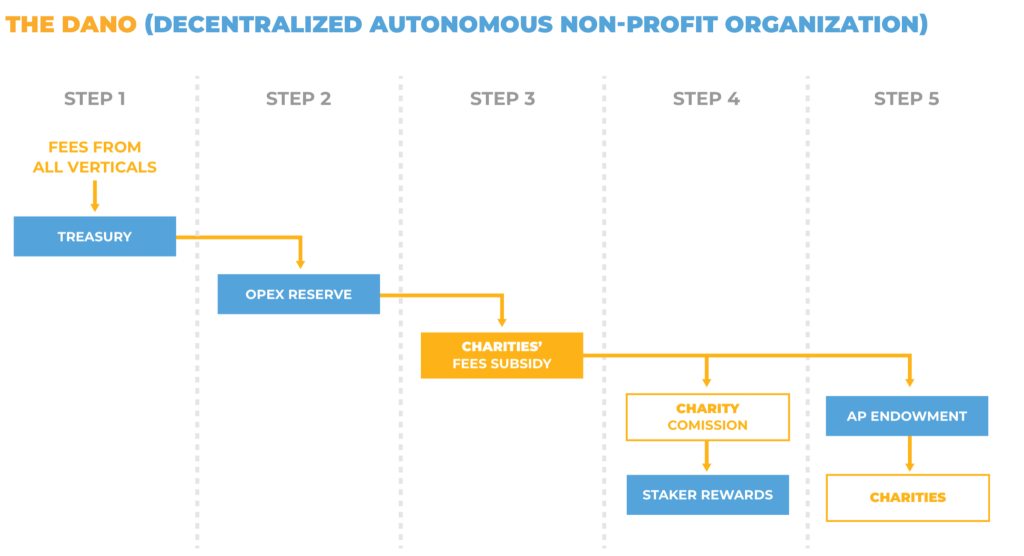


 Foundation of HKPLTW (Canada)