B.C. Treaty Process Controversy: Canadian and Indigenous Perspectives in Land Claims and Aboriginal Title

By Terence Ho | Foundation of HKPLTW

Terence is a Research Coordinator for the Foundation of HKPLTW with interests in history & traditions, social organization & inter-group relations, culture & religion, and economics & politics of Canadian Indigenous People and Visible Minorities. Follow him on Twitter: @hkpltw

Terence is a Research Coordinator for the Foundation of HKPLTW with interests in history & traditions, social organization & inter-group relations, culture & religion, and economics & politics of Canadian Indigenous People and Visible Minorities. Follow him on Twitter: @hkpltw

The B.C. Treaty Process has often been very controversial. First of all, many First Nation communities have dropped out or refused to participate based on their belief that the process extinguishes titles favouring the B.C. government, allowing the provincial government to continue developing lands at the expense of their territories and cultures. Secondly, there is always a significant difference between what the First Nation Peoples see as their “Original Title” to the land and its resources and the Canadian and B.C. legal notion of ‘Aboriginal Title.’ For these reasons, many consider the B.C. Treaty Process to have failed at settling issues of Aboriginal title.  The debates are ongoing, preventing further negotiations from continuing. 

Modern Land Claims and First Nation Perspective

Reconciling the Canadian legal understanding of Aboriginal title with First Nation peoples’ knowledge is not a straight forward task.  The idea that Aboriginal title would be a proprietary right to the land stands in contrast to First Nation peoples’ concept of land ownership. In their concepts, the creator provided the land to them and their future generations. They have argued that they retain inherent land rights to territories given their creator. The lands are not owned, but rather the land and the people exists in a reciprocal relationship. In this regard, Indigenous activists note that Aboriginal title cannot be surrendered but only shared — “First Nation Peoples retain inherent land rights to traditional territories.” 

Based on the First Nation viewpoint, the Royal Commission on Aboriginal People concluded that Aboriginal title does not include “the right to alienate or sell land to outsiders, to destroy or diminish lands or resources, or to appropriate lands or resources for private gain without regard to reciprocal obligations.” Summarizing this viewpoint, the “cede, release, yield up and surrender” written in the land treaties constitute an agreement upon the conditions by which the land would be shared instead of a surrender of Aboriginal title

Although the British Columbian government created B.C. Treaty Process to reach agreement, the disagreement with First Nations regard to Aboriginal title makes the process fruitless. As you can see, the Canadian legal understanding of the Aboriginal title is that it is a burden on the Crown’s underlying title.

In this understanding, the British Columbian government continues to interpret Aboriginal title to be something that can be ceded or transferred only to the Crown. This legal interpretation accepts the Crown’s underlying title as a given, and did not require the Crown to prove or validate its claim to sovereignty. Many First Nation communities are uncomfortable with the legal interpretation made by the government because they believe the interpretation assumes the Crown’s sovereignty without questioning its legitimacy. 

Who is right? I think reconciling the Canadian legal understanding of Aboriginal title with First Nation understanding remains a great challenge. 
Bibliography

Crowe, Keith. “Comprehensive Land Claims: Modern Treaties”. The Canadian Encyclopedia, 11 July 2019, Historica Canada. https://www.thecanadianencyclopedia.ca/en/article/comprehensive-land-claims-modern-treaties. Accessed 16 December 2021.

Dyck, Lillian E., et al. A Commitment Worth Preserving: Reviving the British Columbia Treaty Process. Canada Senate, Ottawa, Ont., 2012.

Malone, Molly and Libby Chisholm. “Indigenous Territory”.  The Canadian Encyclopedia, 05 July 2016, Historica Canada. http://www.thecanadianencyclopedia.ca/en/article/indigenous-territory. Accessed 16 December 2021.

Irwin, Robert. “Aboriginal Title”.  The Canadian Encyclopedia, 25 September 2018, Historica Canada. http://www.thecanadianencyclopedia.ca/en/article/aboriginal-title. Accessed 02 December 2021.

Hanson, Eric. “Aboriginal Title.” Indigenous Foundations. First Nations and Indigenous Studies UBC, 2009. Accessed 16 December 2021.

Raibmon, Paige, “Unmaking native Space: A genealogy of Indian Policy, Settler Practice, and the Microtechniques of Dispossession” in Alexandra Harmon, ed. The Power of Promises: Rethinking Indian Treaties in the Pacific Northwest. Seattle: University of Washington Press, 2008: 56-85.

Tennant, Paul, Aboriginal People and Politics: The Indian Land Question in British Columbia, 1849-1989 Vancouver: UBC Press, 1990.

Woolford, Andrew. “Negotiating Affirmative Repair: Symbolic Violence in the British Columbia Treaty Process.” Canadian Journal of Sociology, vol. 29, no. 1, 2004, pp. 111.

This is an opinion article; the views expressed by me. Follow Me on Twitter: @hkpltw And @Terry_Terence97
Why Reconciling Legal Understanding of Aboriginal Title with Indigenous Understanding Is a Significant Challenge? 

By Terence Ho | Foundation of HKPLTW

Terence is a Research Coordinator for the Foundation of HKPLTW with interests in history & traditions, social organization & inter-group relations, culture & religion, and economics & politics of Canadian Indigenous People and Visible Minorities. Follow him on Twitter: @hkpltw

Terence is a Research Coordinator for the Foundation of HKPLTW with interests in history & traditions, social organization & inter-group relations, culture & religion, and economics & politics of Canadian Indigenous People and Visible Minorities. Follow him on Twitter: @hkpltw

I have mentioned that the B.C. Treaty Process is always controversial because there is always a significant difference between what Indigenous Peoples see as their “Original Title” to the land and its resources and the Canadian and B.C. legal notion of ‘Aboriginal Title. This issue prevents further negotiation from continuing.

In this article, I will explain Aboriginal Tittle in Canadian law, and an Indigenous perspective and why reconciling the Canadian legal understanding of Aboriginal title with Indigenous knowledge remains a significant challenge.

What Is “Aboriginal Title” In Canadian Law

Under the Canadian law, the Aboriginal title is sui generis, or unique collective right to the use of and jurisdiction over a group’s ancestral territories. The land title originates in a First Nation community’s occupation of its ancestral lands before the European assertion of sovereignty.

As such, Aboriginal Title and Rights are separate from rights afforded to Canadian citizens under the common law. In that regard, the Aboriginal Title may not be sold or purchased by individuals; it may only be voluntarily surrendered to the Crown by a First Nation community through treaty agreements. Some First Nations do not agree with these definitions, as they consider Canadian purposes of limiting the scope of Aboriginal Title, making it easier to extinguish.

In B.C., this narrow perspective proved especially controversial. Some claimed that the colony of British Columbia was not subject to the Royal Proclamation. The British Columbian government argued that Aboriginal Title had been extinguished by colonial legislation before the province entered the Canadian Confederation. As a result, no treaties for the surrender of the Aboriginal Title were completed. The Aboriginal Title does not negate the Crown’s sovereign title to the land. Instead, Aboriginal title is a “burden” — a legal acknowledgment of that title — upon the Crown’s underlying Title. The governance of those areas where Aboriginal Title is recognized, and the implications for private property rights, have not yet been thoroughly defined.

First Nation Perspectives of Aboriginal Tittle and Land

First Nation peoples across Canada and B.C. have maintained a solid connection to the land. Even though there is vast cultural variation between First Nations, most groups held similar beliefs that governed their relationship with and responsibility to the ground.

Most First Nation communities did not believe that pieces of land could or should be owned by particular individuals. Humans, along with all other living beings, belonged to the ground. The land provided for humanity, and in turn, society bore a responsibility to respect and care for it. Many First Nation peoples understand this as a reciprocal relationship with the land because they do not own the lands

Aboriginal Tittle: A Great Challenge

Reconciling the legal understanding of Aboriginal title with First Nation understanding remains a significant challenge. For example, the First Nations believe that Aboriginal Title cannot be surrendered but only shared. The concept of private property ownership is an idea introduced by the European settlers.

The idea that Aboriginal title would be a proprietary right to the land stands in contrast to Indigenous concepts of land ownership. Thus, Canadian sovereignty over lands is not dependent upon an agreement with First Nations concerning Aboriginal title, and reconciling the Canadian legal understanding of Aboriginal title with Indigenous knowledge remains a significant challenge.

Bibliography

Crowe, Keith. “Comprehensive Land Claims: Modern Treaties”. The Canadian Encyclopedia, 11 July 2019, Historica Canada. https://www.thecanadianencyclopedia.ca/en/article/comprehensive-land-claims-modern-treaties. Accessed 23 November 2021.

Dyck, Lillian E., et al. A Commitment Worth Preserving: Reviving the British Columbia Treaty Process. Canada Senate, Ottawa, Ont., 2012.

McNeil, Kent. “The Meaning of Aboriginal Title.” In Michael Asch, ed.  Aboriginal and Treaty Rights in Canada: Essays on Law, Equality, and Respect for Difference. Vancouver: UBC Press, 1997. 135-154.

Woolford, Andrew. “Negotiating Affirmative Repair: Symbolic Violence in the British Columbia Treaty Process.” Canadian Journal of Sociology, vol. 29, no. 1, 2004, pp. 111.

Green, Arthur, et al. British Columbia in a Global Context. Geography Open Textbook Collective, 2014.

Hanson, Eric. “Aboriginal Title.” Indigenous Foundations. First Nations and Indigenous Studies UBC, 2009. Accessed 23 November 2021.

This is an opinion article; the views expressed by me. Follow Me on Twitter: @hkpltw And @Terry_Terence97
Controversy and Uncertainty:  Why is the B.C. Treaty process not Successful at Settling Issues of Aboriginal Title? 

By Terence Ho | Foundation of HKPLTW

Terence is a Research Coordinator for the Foundation of HKPLTW with interests in history & traditions, social organization & inter-group relations, culture & religion, and economics & politics of Canadian Indigenous People and Visible Minorities. Follow him on Twitter: @hkpltw

Terence is a Research Coordinator for the Foundation of HKPLTW with interests in history & traditions, social organization & inter-group relations, culture & religion, and economics & politics of Canadian Indigenous People and Visible Minorities. Follow him on Twitter: @hkpltw

British Columbia Treaty Process (BCTP) is the modern negotiation process in B.C. Its main goal is to resolve outstanding land claims issues and reach a partial agreement with First Nations over the title in the 90s. In the last article, I explain the six stages of the process. In this article, I will expand and explain why the B.C. treaty process is controversial and why it is not entirely successful at settling issues of Aboriginal title. 

Differences in the Understandings of Aboriginal Title

I believe B.C. Treaty Process is a necessary first step for both the First Nations and B.C. governments. The process was established in 1991, which provides a guideline for treaty-making that includes a list of 19 principles for negotiations. However, these 19 principles are overly vague, allowing the parties a considerable amount of leeway to how they fashion their participation in the process. Because of this, many treaties falls short. One topic that prevents negotiation from continuing is the differences between the non-Aboriginal and First Nation sides on the “Understanding of Aboriginal Titles.” 

The B.C. government’s interpretations of “Aboriginal title” differs from First Nation understandings of title. For the government, the Aboriginal title can be ceded or transferred only to the Crown. Many First Nation communities view the interpretation to be controversial — it favours the B.C. government as it assumes the Crown’s sovereignty without questioning its legitimacy

Many First Nation activists argue with their definition of ”Aboriginal title.” By defining Aboriginal title using B.C. and Canadian law concepts, they say that the underlying complexities within First Nation understandings of title (based on a reciprocal relationship to the land) are circumscribed.  Furthermore, some organizations, such as the UBCIC, argue that the emphasis on legal definitions of Aboriginal title detracts from how title may or may not be recognized and how First Nation communities may assert their title in day-to-day experiences.

As a result, numerous First Nation activist organizations refuse to accept the B.C. government’s definitions of Aboriginal title. They refuse to resolve issues of Aboriginal title using non-First Nations systems like The B.C. Treaty Process.

First Nations: Aboriginal Title Doesn’t Mean Private Property

To most Canadians and our law system, we would define Aboriginal tittle as a “legal ownership of their lands”. However, the First Nations believe that their tittle to their homelands are rooted in a reciprocal relationship to the land. They argue that the Canadian land ownership system is inequitable to Aboriginal tittle, and the Canadian view of Private Property has marginalized First Nation peoples in their own homelands in order for non-Aboriginal interests to profit off First Nation territories. This belief explains why many First Nation groups have dropped out or refused to participate in the B.C. Treaty process, believing that the process tries to extinguish title in favour of government.

Conclusion: A Tough Road Ahead To Settle Issues

The B.C. Treaty Process is full of controversy and uncertainty. Both the non-Aboriginal and First Nation seem to be no common grounds regarding the issue of Aboriginal Title. First Nations believe that outstanding Aboriginal title does not mean that private property will be confiscated. On the other hand, the B.C. government states that land is personal property, meaning that a homeowner would be evicted from one’s home if one does not have legal documents to prove one’s ownership. 

As of 2021, the current state of B.C. Treaty Process fails at settling issues of Aboriginal title in B.C. This process is very controversial, and the debates are ongoing. Until there is a way that allows progressive First Nation interests while respecting the Canadian law system — The B.C. Treaty Process will remain controversial and will not be entirely successful at settling issues of Aboriginal title. 

Bibliography

McNeil, Kent. “The Meaning of Aboriginal Title.” In Michael Asch, ed.  Aboriginal and Treaty Rights in Canada: Essays on Law, Equality, and Respect for Difference. Vancouver: UBC Press, 1997. 135-154.

Raibmon, Paige, “Unmaking native Space: A genealogy of Indian Policy, Settler Practice, and the Microtechniques of Dispossession” in Alexandra Harmon, ed. The Power of Promises: Rethinking Indian Treaties in the Pacific Northwest. Seattle: University of Washington Press, 2008: 56-85.

Tennant, Paul, Aboriginal People and Politics: The Indian Land Question in British Columbia, 1849-1989 Vancouver: UBC Press, 1990.

Woolford, Andrew. “Negotiating Affirmative Repair: Symbolic Violence in the British Columbia Treaty Process.” Canadian Journal of Sociology, vol. 29, no. 1, 2004, pp. 111.

Union of British Columbia Indian Chiefs. Stolen Lands, Broken Promises: Researching the Indian Land Question in British Columbia. (2nd ed.) Vancouver: UBCIC, 2005.

This is an opinion article; the views expressed by me. Follow Me on Twitter: @hkpltw And @Terry_Terence97

Remembrance Day: Visible Minorities And First Nation Veterans Fought for Equality And Respect

By Terence Ho | Foundation of HKPLTW

Terence is a Research Coordinator for the Foundation of HKPLTW with interests in history & traditions, social organization & inter-group relations, culture & religion, and economics & politics of Canadian Indigenous People and Visible Minorities. Follow him on Twitter: @hkpltw

Terence is a Research Coordinator for the Foundation of HKPLTW with interests in history, social organization, inter-group relations, culture, and politics of Canadian Indigenous People and Visible Minorities. Follow him on Twitter: @hkpltw

“We have to broaden our understanding of the past to include the stories that were always there but that we weren’t telling. It’s a validation that these stories matter in our history.”

Britt Braaten, creative development specialist, Canadian War Museum

No matter where the soldier fought, the soldier gave their lives for this country; we should pay proper respects to all of them. Many have gone to war to prove their allegiance to Canada, but for thousands of visible minorities and First Nations, it went beyond that. For these recruits, it was more than a spirit of perilous adventure or proving their allegiance to this nation that prompted them to sign up for military services. It was mainly an assertion of their equality and the belief they were entitled to more than second-class citizenship. And a way to show they deserved the coveted right to vote and participation in certain professions (e.g. doctor, engineer)..

The stories of these veterans are mostly silent about their services to Canada. When they returned, they shed their uniforms, took up civilian lives, and never talked about what they did during the war. Their stories are disappearing, as many veterans carried their bottled-up memories to their graves. However, their legacies remain. They are the real heroes whose contributions to helping new generations of visible minorities and First Nations win equality, justice, and respect. Canada’s colonial legacy and racism has meant First Nation and visible minority veterans have had to fight to get the commemoration they deserve. Their bravery and loyalty to a nation that mistreated them remains little-known to Canadians. These veterans fought hard to for a change in our communities and a positive reputation — they would be undertaking their dangerous missions on behalf of a nation that ostracized them and denied them citizenships and civil rights.

The sacrifices that the veterans made to win civil rights should not be forgotten. The citizenship and opportunities that the newer generations enjoy today — These veterans went to the war, risked their lives, and fought for it. They took the discrimination on their shoulders, so the newer generations do not have to face it. So, if you see a veteran on Remembrance Day, please say thank you to them! 

This is an opinion article; the views expressed by me. Follow Me on Twitter: @hkpltw And @Terry_Terence97

Bibliography

Velez, Irena. “War museum enhances content on Remembrance Day virtual resource to share ‘stories we weren’t telling’.”Art & Culture. Capital Current, 2021. Accessed 10 November 2021.

A Very Controversial Process: What Makes British Columbian Modern Treaties Different From the Rest of Canada?

By Terence Ho | Foundation of HKPLTW

Terence is a Research Coordinator for the Foundation of HKPLTW with interests in history & traditions, social organization & inter-group relations, culture & religion, and economics & politics of Canadian Indigenous People and Visible Minorities. Follow him on Twitter: @hkpltw

Terence is a Research Coordinator for the Foundation of HKPLTW with interests in history & traditions, social organization & inter-group relations, culture & religion, and economics & politics of Canadian Indigenous People and Visible Minorities. Follow him on Twitter: @hkpltw

Difference: B.C. Refused to Federal’s Claim Process

In British Columbia, treaties were traditionally not negotiated between the government and First Nation peoples. As First Nation activists would argue for years, Aboriginal title is therefore not officially extinguished, and legally they retained ownership and rights over their land properties. British Columbian government’s stance had to reflect the Calder case in 1973, the first court case to acknowledge the continued existence of Aboriginal title. However, there remained divisions on whether or not Aboriginal title ever existed in BC.

Determining the potential presence of Aboriginal title would be the responsibility of the Crown, even though the burden of proof entirely rests on First Nations to prove it exists. In response to the division on Aboriginal title, the federal government developed a comprehensive claims process for dealing with grievances related to claims to land where, in the perspective of the Crown, the question of Aboriginal title had never been addressed through historical treaties. 

Despite the federal government’s claim processes, the British Columbian government refused to cooperate, and issues of outstanding Aboriginal title in BC remained. In the 90s, things started to change when First Nation activists throughout the province protested in desperate attempts to have the BC government recognize their right to jurisdiction over their land. These direct actions had come after more than a century of failed petitions and negotiating with the government. Due to the pressures from the protests, the government set up British Columbia Treaty Process (BCTP) to finally reach agreements with First Nation activists over the title. 

British Columbia Treaty Process: What Makes It Speical?

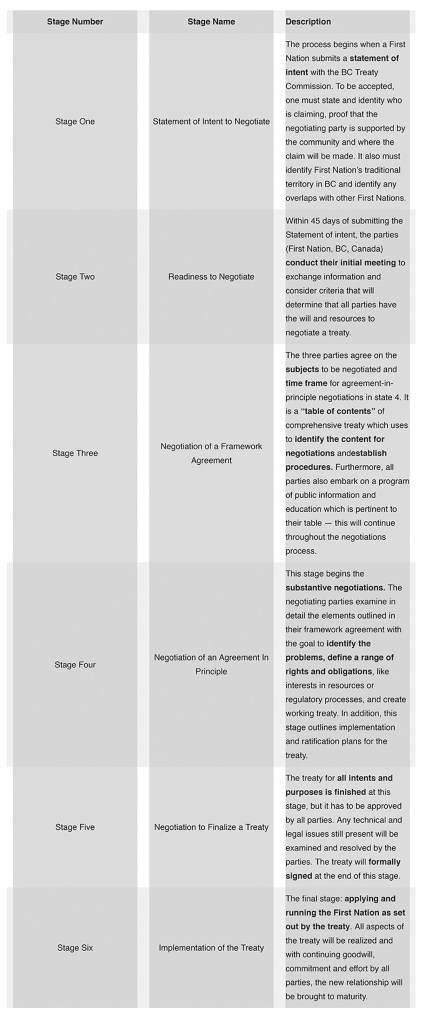
First, I want to point out that BCTP is a voluntary process, commonly described as the “keeper of the process,” because it does not negotiate treaties but helps ensure a fair, impartial, practical and understandable process. Furthermore, please note that not all First Nations communities are participating. Since it was created, the majority of the current treaty negotiations in BC have occurred within the BCTP. Within the BCTP, 60 First Nations participate in 49 sets of negotiations, representing about two-thirds of all First Nations people in BC. As a process, the BCTP includes Six stages, as outlined in the table below.

Stage NumberStage NameDescription
Stage OneStatement of Intent to NegotiateThe process begins when a First Nation submits a statement of intent with the BC Treaty Commission. To be accepted, one must state and identity who is claiming, proof that the negotiating party is supported by the community and where the claim will be made. It also must identify First Nation’s traditional territory in BC and identify any overlaps with other First Nations.
Stage TwoReadiness to NegotiateWithin 45 days of submitting the Statement of intent, the parties (First Nation, BC, Canada) conduct their initial meeting to exchange information and consider criteria that will determine that all parties have the will and resources to negotiate a treaty.
Stage ThreeNegotiation of a Framework AgreementThe three parties agree on the subjects to be negotiated and time frame for agreement-in-principle negotiations in state 4. It is a “table of contents” of comprehensive treaty which uses to identify the content for negotiations and establish procedures. Furthermore, all parties also embark on a program of public information and education which is pertinent to their table — this will continue throughout the negotiations process.
Stage FourNegotiation of an Agreement In PrincipleThis stage begins the substantive negotiations. The negotiating parties examine in detail the elements outlined in their framework agreement with the goal to identify the problems, define a range of rights and obligations, like interests in resources or regulatory processes, and create working treaty. In addition, this stage outlines implementation and ratification plans for the treaty.
Stage FiveNegotiation to Finalize a TreatyThe treaty for all intents and purposes is finished at this stage, but it has to be approved by all parties. Any technical and legal issues still present will be examined and resolved by the parties. The treaty will formally signed at the end of this stage.
Stage SixImplementation of the TreatyThe final stage: applying and running the First Nation as set out by the treaty. All aspects of the treaty will be realized and with continuing goodwill, commitment and effort by all parties, the new relationship will be brought to maturity.
Stages of Treaty Negotiations

Has BCTP Been Successful?

Since its debut in 1992, the British Columbia Treaty Process has not been entirely successful. Many First Nation communities have dropped out or refused to participate based on their belief that the process favours the government, allowing the government to continue developing lands at the expense of First Nations, territories and cultures. As a result, a few treaties have been completed under BCTP.

As of 2021, the majority of the treaties involved in BCTP are in Stage 4. Many treaties fell short when both parties have conflicts over the elements outlined in their framework agreement with the goal to identify the problems, define a range of rights and obligations, like interests in resources. So far, the Nisga’a agreement is the first and only successful modern land treaty in B.C..

Personally, I believe that British Columbia Treaty Process is a necessary first step for both the First Nations and B.C. government. However, the current state of BCTP failed at settling issues of Indigenous tittle in B.C. BCTP is very controvial, and the deabtes are ongoing.

This is an opinion article; the views expressed by me. Follow Me on Twitter: @hkpltw And @Terry_Terence97

Bibliography

Crowe, Keith. “Comprehensive Land Claims: Modern Treaties”. The Canadian Encyclopedia, 11 July 2019, Historica Canada. https://www.thecanadianencyclopedia.ca/en/article/comprehensive-land-claims-modern-treaties. Accessed 09 November 2021.

Dyck, Lillian E., et al. A Commitment Worth Preserving: Reviving the British Columbia Treaty Process. Canada Senate, Ottawa, Ont., 2012.

Green, Arthur, et al. British Columbia in a Global Context. Geography Open Textbook Collective, 2014.

Hanson, Eric. “Aboriginal Title.” Indigenous Foundations. First Nations and Indigenous Studies UBC, 2009. Accessed 8 November 2021.

“Overview of Treaty Negotiations in B.C. ” Government of Canada. Nisga’a Final Agreement and Background Information, https://www.rcaanc-cirnac.gc.ca/eng/1100100031304/1543410622429. Accessed 4 November 2021. 

“The Six Stage Negotiation Process.” FIRST NATIONS SUMMIT. Treaty Negotiation, https://fns.bc.ca/treaty-negotiation-process-in-bc/six-stage-negotiation-process. Accessed 7 November 2021.

Indigenous Treaty Process Across Canada and Around the World

By Terence Ho | Foundation of HKPLTW

Terence is a Research Coordinator for the Foundation of HKPLTW with interests in history & traditions, social organization & inter-group relations, culture & religion, and economics & politics of Canadian Indigenous People and Visible Minorities. Follow him on Twitter: @hkpltw

Terence is a Research Coordinator for the Foundation of HKPLTW with interests in history, social organization, inter-group relations, culture, and politics of Canadian Indigenous People and Visible Minorities. Follow him on Twitter: @hkpltw

In this article, I will examine Indigenous issues and treaties around the globe: How they fight for their collective rights and individual rights, and how indigenous efforts are aimed at making common cause, first regionally and then globally. In addition, I will access the Indigenous treaties and issues in Canada and British Columbia: How treaties have proceeded and successes can be measured

Indigenous Activism and Negotiations: Global Movement

There are an estimated 370 million Indigenous peoples worldwide. Despite being culturally different, Indigenous populations around the world share similar struggles. In any situation, the settler population is typically often more dominant and populous. In contrast, the indigenous people have become socio-economically disadvantaged and vulnerable to discriminatory state policy and even outright armed repression. Throughout history, there have been many systemic policies attempting to assimilate both by military force and through more subtle pressures to conform to mainstream society. 

Beginning in the 1970s, indigenous leaders worldwide began to unite with other indigenous groups to increase their effectiveness in the fight for their rights.  As more indigenous peoples have organized across geographic and political borders, there was a significant increase in international attention to their everyday struggles despite their vastly different cultures and locations. Indigenous efforts were aimed both at making common causes, first regionally and then globally.

In Canada, for example, the Assembly of First Nation provides a voice to all of the First Nation communities in federal politics and on the international stage. It participated in drafting the United Nations Declaration on the Rights of Indigenous Peoples. On the domestic front, it worked on constitutional amendments and treaties during the 1980s, the Charlottetown Accord and the Meech Lake Accord. In addition, transnational indigenous organizations have been created all around the world. An example is the Coast Salish Gathering in the Pacific Northwest, a multinational organization representing Coast Salish people on both sides of the British Columbia – Washington State border. Despite the political border, members propose recommendations on issues in their shared homeland (e.g. resource extraction) and draft negotiations (e.g. land and fishing rights) with governments on both sides of the border collectively. 

Treaty Process in Canada and British Columbia

Like Indigenous leaderships in other places, First Nations across Canada create provincially and nationally based organizations that express their desire and goal for equality with mainstream Canada while maintaining their cultural heritage. Throughout the years, the First Nation organizations facilitated negotiations and made the processes for treaties and collective rights.

Throughout the years, the First Nation organizations facilitated negotiations. They made the processes for treaties and collective rights. Beginning with the infamous “White Paper” in 1969, the forceful opposition from First Nation organizations across the country sparked a new era of Indigenous political activism in Canada. It is easy to see why the White Paper was so hated. It did little at catalyzing structural change and at accountability; there is little hope that past harms and ongoing legacy of assimilation policies are being held accountable. It contained no provisions to recognize First Nations’ rights, or to handle and deal with historical grievances such as the land claims and treaty rights, or to facilitate meaningful Indigenous participation in Canadian policymaking.

First Nation activists from united in new associations determined to protect and promote their collective rights and interests. In British Columbia, First Nations across the province came together in new ways — invited bands to a conference in Kamloops, BC, where they discussed the fight for recognition of their peoples’ title and rights. This conference in Kamloops led to organizations such as the Union of British Columbia Indian Chiefs and the formation of a negotiation process such as the British Columbia Treaty Process — which aims to resolve and develop collective responses to outstanding issues, including indigenous rights and title to the land. 

In addition, the First Nation organizations proposed their policy alternatives. The Indian Association of Alberta, for example, argued in a paper entitled Citizens Plus that First Nation peoples held rights that other Canadians did not. Rallying around this concept, these activists argued that their people were allowed all the benefits of Canadian citizenship, in addition to special rights deriving from their unique relationship with the Crown. 

Conclusion

Throughout the mid 20th century, for aboriginal peoples across the globe and Canada, Indigenous political organizing started as a combined effort to abolish the paternalistic policies. With increased transnational and united fronts organizing, there has been an increased support for Indigenous rights and a growing awareness of the importance of self-determination for Indigenous peoples worldwide. The growth in Aboriginal politics contributed to a surge of political organizing and movements toward recognizing Aboriginal rights. 

This is an opinion article; the views expressed by me.

You May be Interested in:

The Road to Political Organizing and Activism For First Nations

Bibliography

Cairns, Alan, and Xwi7xwa Collection. Citizens Plus: Aboriginal Peoples and the Canadian State. UBC Press, Vancouver, 2000.

Dyck, Noel and Tonio Sadik. “Indigenous Political Organization and Activism in Canada”. The Canadian Encyclopedia, 04 December 2020, Historica Canada. https://www.thecanadianencyclopedia.ca/en/article/aboriginal-people-political-organization-and-activism. Accessed 20 October 2021.

“First Nations in Canada. ” Government of Canada. Indigenous Peoples and Community, https://www.rcaanc-cirnac.gc.ca/eng/1307460755710/1536862806124#chp1. Accessed 19 October 2021. 

“Global Action.” Indigenous Foundations. First Nations and Indigenous Studies UBC, 2020. Accessed 19 October 2021.

Milloy, John. “Indian Act Colonialism: A Century of Dishonour. 1869-1969.” National Centre for First Nations Governance, 2008. http://fngovernance.org/ncfng_research/milloy.pdf

Lagace, Naithan and Niigaanwewidam James Sinclair. “The White Paper, 1969”. The Canadian Encyclopedia, 10 June 2020, Historica Canada. https://www.thecanadianencyclopedia.ca/en/article/the-white-paper-1969. Accessed 20 October 2021.

Sanders, Douglas. “The Formation of the World Council of Indigenous Peoples.” April 1980, Fourth World Documentation Project, Center for World Indigenous Studies. https://www.cwis.org/document/the-formation-of-the-world-council-of-indigenous-peoples-by-douglas-sanders-april-1980-2/

Tennant, Paul, desLibris – Books, and Canadian Publishers Collection. Aboriginal Peoples and Politics: The Indian Land Question in British Columbia, 1849-1989. University of British Columbia Press, Vancouver, 1990.

“The White Paper 1969.” Indigenous Foundations. First Nations and Indigenous Studies UBC, 2020. Accessed 19 October 2021. https://indigenousfoundations.arts.ubc.ca/the_white_paper_1969/

First Nation Fishery: How Do They Harvest and Conserve Fish Resources?

By Terence Ho | Foundation of HKPLTW

Terence is a Research Coordinator for the Foundation of HKPLTW with interests in history & traditions, social organization & inter-group relations, culture & religion, and economics & politics of Canadian Indigenous People and Visible Minorities. Follow him on Twitter: @hkpltw

Terence is a Research Coordinator for the Foundation of HKPLTW with interests in history & traditions, social organization & inter-group relations, culture & religion, and economics & politics of Canadian Indigenous People and Visible Minorities. Follow him on Twitter: @hkpltw

In this article, I will examine the First Nation fishery in British Columbia. I will explore how the “food fishery” came to be and how it has worked to conserve salmon for the benefit of the non-Native industrial fishery. 

For the First Nations in BC, the fishery has always been a source of food, wealth, and trade and is always intricately tied to their continued existence. The vast food resources of the ocean — salmon, shellfish, herring, crabs, seaweed, and whale — made it possible for Pacific Coast First Nations of British Columbia to settle in permanent locations. They dried most of their salmon in smokehouses to be stored and eaten later. Fish oil also played an essential part in their diet, serving as a condiment with dried fish during the winter. As a result, the fishery is critical to both the leading economy and traditional heritage of the Pacific Coast First Nations. 

Conflicts With Non-First Nation Fishers?

During the salmon fishing season, tensions between First Nation and non-First Nation fishers are commonplace in British Columbia. The conflict arises over a priority that only allows some salmon caught by the First Nation fishers to be sold commercially. The non-native commercial fisher group, the BC Fisheries Survival Coalition, has called for an end to what they have termed “racially divided fisheries programs,” arguing that all fishermen should have equal access to the fishery. The non-First Nation fishers worry that there are not enough resources for everyone, and they further question why First Nation fishers do not make concessions to help conserve and share a common resource? 

Non-First Nation’s argument is problematic and goes against concepts of First Nation traditions and rights. First, the First Nation peoples are not “stakeholders” of the fishery resources, and their harvesting practices have special status under Canadian law.  Most importantly, the First Nation fisher communities successfully managed to fish for thousands of years before the white settlers and any regulations by the Canadian state. First Nation peoples had already built flourishing economies based on fisheries. Salmon, according to the oral histories of the First Nation peoples, are considered “gift-bearing relatives and treated with profound respect.”

First Nation Traditional View of Fishery?

The First Nation fisheries management is described as a successful collaboration between the fishers and salmon:

At the end of the net, a ring of willow was woven into the net, which allowed some salmon to escape.  This is more than just a simple act of conservation. It represents a profound respect for salmon.  It was believed that the runs of salmon were lineages, and if some were allowed to return to their home rivers, then those lineages would always continue.”

Nick Claxton

For example, the WSÁNEC people believe that all salmon were once human beings, thus should be respected as living things. Out of respect, a ten days ceremony is conducted when first salmon stocks of the year is caught. This celebration allows for a major portion of the salmon stocks to return to their revivers to spawn and mature, and to sustain those stocks. 

In addition, drying salmon process needs to be adapted to yearly salmon runs. For instance, the wind-drying of salmon in Fraser Canyon heavily depends on humidity and temperature. When it is humid and hot, dry winds blew into the Canyon. Salmon are only caught from particular spots, and then hang on rock bluffs, where the salmon could be dried before arrival of blowflies and wasps. Despite government intervention, and changes in technology to fishing by boat with gill nets, First Nation traditional fishing practices never changed. 

First Nation Harvest Method

The First Nation practices of fisheries allow for them to monitor the fish populations carefully, everyone to have an equal share of runs of fishes at the same site, and develop sophisticated harvesting techniques. In general, most First Nation fishers uses dip-nets to fish, or uses weirs to channel fishes into traps in the shallower and slow-moving water. At some locations, stone traps were used to trap salmon at low tide; an arc of stones created shallow pools from which salmon could be selectively harvested by waiting fishers, who tapped the surface of the water behind the trap until the water level had dropped below the level of the stones.

In addtion, since fisheries require the allocation and sharing of seasonal resources between families and tribes, fisheries management is not a distinct practice — it is separated from law and governance. This management system is integrated with systems of privilege, distinct forms of production and exchange, as the decisions about fishing access and rights to fishing places are made by the elders. In addition, since rank and prestige were associated with distributing, rather than accumulating wealth, there was little danger of title-holders hoarding resources for their individual benefit.

Overall, First Nation fishing techniques are very productive. Their technologies and techniques allow First Nation fishers to gather food and conserve fish resources for future generations. Their timing and harvest level were regulated through systems that modern scientists would call “Resource Management.” For thousands of years, the First Nations have developed specialized techniques to deal with large quantities of fish. 

This is an opinion article; the views expressed by me.

Bibliography

“Aboriginal FIsheries in British Columbia.” Indigenous Foundations. First Nations and Indigenous Studies UBC, 2020. Accessed 15 October 2021.

Butler, Caroline. “Regulating Tradition: Sto:lo Wind Drying and Aboriginal Rights” (M.A. Thesis, University of British Columbia, Vancouver, 1998).

Carlson, Keith Thor. “History Wars: Considering Contemporary Fishing Site Disputes,” in A Sto:lo Coast Salish Historical Atlas, ed. Keith Thor Carlson (Vancouver: Douglas & McIntyre, 2001), 58.

Claxton, Nicholas Xumthoult, “ ISTÁ SĆIÁNEW, ISTÁ SXOLE: ‘To Fish as Formerly:’ The Douglas Treaties and the WSÁNEĆ Reef-Net Fisheries.” In Lighting the Eighth Fire: The Liberation, Resurgence, and Protection of Indigenous Nations, ed. Leanne Simpson (Winnepeg, Arbeiter Ring, 2008), 52-55.

“First Nations in Canada. ” Government of Canada. Indigenous Peoples and Community, https://www.rcaanc-cirnac.gc.ca/eng/1307460755710/1536862806124#chp1. Accessed 15 October 2021.

Harris, Douglas. Fish Law and Colonialism: The Legal Capture of Salmon in British Columbia. Toronto: University of Toronto Press, 2001.

Menzies, Charles and Caroline Butler, “Returning to Selective Fishing Through Indigenous Fishing Knowledge,” American Indian Quarterly 31, 3 (2007): 451-452.

Weinstein, Martin. “Pieces of the Puzzle: Solutions for Community-Based Fisheries Management from Native Canadians, Japanese Cooperatives, and Common Property Researchers,” The Georgetown International Environmental Law Review 12 (2000): 375-412.

Indigenous Funding and Finance (Part Three):What Would be the Improvement Needed a Fruitful Future?

By Terence Ho | Foundation of HKPLTW

Terence is a Research Coordinator for the Foundation of HKPLTW with interests in history & traditions, social organization & inter-group relations, culture & religion, and economics & politics of Canadian Indigenous People and Visible Minorities. Follow him on Twitter: @hkpltw

Terence is a Research Coordinator for the Foundation of HKPLTW with interests in history & traditions, social organization & inter-group relations, culture & religion, and economics & politics of Canadian Indigenous People and Visible Minorities. Follow him on Twitter: @hkpltw

This is Part Three of three-part-series on Indigenous Funding and Finance in Canada. In Part One, I described methods that the federal government provided to fund Canadian Indigenous peoples on and off reserves. In Part Two, I explained why federal government’s funding and services are deficient and how they cannot keep pace with the growing Canadian Indigenous population. In this article, I will conclude with what I think would be the much-needed improvements for Indigenous Funding and Finance.

Disastrous Situation: Any Hope for Improvement?

As I mentioned in my last article (Part Two), I argued that the federal government has not always focus on standards or result to be achieved, resulting in deficient services and resources for Canadian Indigenous peoples.By every measure, levels of poverty (50% of the children on reserve live in poverty), average life spans (life expectancy on the reserve is a decade less than other Canadians), inadequate housing (60 % of the reserve residents live in sub-standard housing), dramatically disproportionate levels of access to government services such as health care, education, and child protection, Indigenous peoples across this nation face livelihood issues that prevented them from succeeding in the contemporary world. Viewing over Canada’s history, the outcomes of Indigenous funding have been adverse, and in many cases, disastrous. So, is there any glimmer of hope for improvement? 

Glimmer of Hope: First Nation Education System Reform

It is easy to list failures of Aboriginal funding and finance in Canada. However, it is difficult to do about failures. The complexities of colonial legacy and evolving legal decisions add to the challenge of reshaping the Indigenous and Canadian relationship. However, I believe that there is an idea worth considering. 

In my opinion, the most realistic idea is the reformation of education for the Indigenous community. Like what Nelson Mandela said, “Education is the most powerful weapon which you can use to change the world.” When it comes to keeping pace with improvement for Indigenous peoples, nothing is more critical than ensuring a system of education that helps them succeed in the contemporary world. The gap in educational outcomes between First Nation peoples and general population is stark. Compared to the 90 % of non-Indigenous Canadian aged 20-24 who received a high school diploma, the rate is 42 % of Indigenous people. Not surprisingly, the large gap causes disastrous aftermaths —  unemployment rate on reserves is 25 %, with 54 % dependent on government transfers as a primary source of income.

For all its shortcomings, the First Nation education is failing these children. A report by the Standing Senate Committee on Aboriginal Peoples in 2011 characterized this problem by saying:

“The federal role is not merely to fund First Nations educational services; it is to work, hand in glove, with First Nations to help build their educational capacity and institutions so that they are able to deliver an effective educational program to their students, comparable to provincial and territorial offerings.”

Standing Senate Committee on Aboriginal Peoples

I agree with the report. Aside from the lack of proper funding, a lack of an appropriate administration system and a teaching staff in constant flux yield poor results on basic measures of expected educational outcomes. A Institute Paper by Michael Mendelson on First Nation Education: “Whole system reform is exactly what is urgently required for First Nations education…if they are to have a school system, and not just a collection of schools, full control and ownership of schools must be vested in First Nations school boards and not individual bands.

Many schools on reserves operate independently, lacking coherence among funding arrangements and public oversight through school board elections to ensure quality education. I firmly believe that the First Nation education system urgently needs not only proper funding to maintain but also requires a proper capacity of resources and administrative expertise to provide children with the best education and resources available. 

Conclusion

In conclusion, I believe that idea of a reformed First Nations school education is the most realistic idea which the federal government should take into consideration. Indeed reformation of First Nation education is part of improving a more fruitful relationship between Indigenous and non-Indigenous peoples. However, it is also a realization that outcomes show Canadians that the current federal funding and financial system are failing Indigenous people.

This is an opinion article; the views expressed by me.

Bibliography

Board, National Aboriginal Economic Development, and desLibris – Documents. Aboriginal Economic Progress Report 2015. National Aboriginal Economic Development Board, Place of publication not identified, 2015.

desLibris – Documents, and Standing Senate Committee on Aboriginal Peoples. Reforming First Nations Education: From Crisis to Hope. Canada. Senate Committee Reports, Place of publication not identified, 2011.

MacDonald, David, Macdonald, and desLibris – Documents. Poverty Or Prosperity: Indigenous Children in Canada. Canadian Centre for Policy Alternatives, 2013.

Mendelson, Michael, et al. Why we Need a First Nations Education Act. Caledon Institute of Social Policy, Place of publication not identified, 2009.

McCue, Harvey. “Op-Ed: First Nations Elementary & Secondary School Education – A National Dilemma.” Critical Social Work, vol. 19, no. 2, 2018, pp. 111-123.

“Rat-infested home underscores housing issues on First Nations, chief says”. CBC News Canada. 2016. Accessed 29 September 2021.  https://www.cbc.ca/news/canada/manitoba/sandy-bay-first-nation-housing-1.3836216.

PICARD, ANDRE. “Native Health Care is a Sickening Disgrace: Second Opinion.” The Globe and Mail. 2005. Accessed 29 September 2021. https://www.theglobeandmail.com/life/health-and-fitness/native-health-care-is-a-sickening-disgrace/article739904/.

Indigenous Funding and Finance (Part Two): Have Funding and Resources Kept Pace With Population Growth?

By Terence Ho | Foundation of HKPLTW

Terence is a Research Coordinator for the Foundation of HKPLTW with interests in history & traditions, social organization & inter-group relations, culture & religion, and economics & politics of Canadian Indigenous People and Visible Minorities. Follow him on Twitter: @hkpltw

Terence is a Research Coordinator for the Foundation of HKPLTW with interests in history & traditions, social organization & inter-group relations, culture & religion, and economics & politics of Canadian Indigenous People and Visible Minorities. Follow him on Twitter: @hkpltw

In the previous article (Part One), I presented a brief description of “How does the Canadian federal government fund Canadian Indigenous Communities?” and I ended my writing with a personal opinion of Canada’s Indigenous funding and financial program. I wrote that a lack of clarity about the overall objectives and a lack of coherence among funding arrangements prevent the federal government from providing its services to all communities across the nation.

The aim of this article (Part Two) is for me to expand on my opinion, discussing whether federal funding and resources have kept pace with the growing Canadian Indigenous population. 

Deficient Funding and Services

While the federal government of Canada state the Aboriginal funding and resources to be provided, they do not always focus on standards or result to be achieved. When it comes to keeping pace with needs, the current federal funding and resources have trouble dealing with everyday problems such as inadequate education and housing that prevented them from succeeding in the contemporary world. The issue is most grim in the context of the education gap between Indigenous peoples living on reserves and non-Indigenous Canadians. Compared to the 90 % of non-Indigenous Canadian aged 20-24 who received a high school diploma, the rate is 42 % of Indigenous people. Not surprisingly, the unemployment rate is also bleak. The unemployment rate on reserves is 25 %, with 54 % dependent on government transfers as a primary source of income. Furthermore, 40 % of Indigenous children are living in poverty—the total rises to 50 % on First Nations reserves—while the child poverty in the rest of Canada is 15 %. This is ridiculous!

One can go on. The current funding has not kept pace with the increasing shortage of adequate housing problems on some Indigenous reserves. Often, reality confronts the general public when reports show the desperate conditions some First Nation people endure. For instance, a CBC news article reported houses unfit for human habitation on the Sandy Bay Reserve in Manitoba. According to the chief of that reserve, 60 % of the residents live in sub-standard housing, in many cases with no proper sewage, clean insulation, and overcrowded household. Furthermore, as one might expect, native health care is similarly deficient. One example from a Globe and Mail article, the suicide rate for Canadian Indigenous people is six times higher than for other Canadians, and their life expectancy is a decade less than for other Canadians. 

Conclusion: What Do I Think?

All in all, funding and resources have not kept pace with Canadian Indigenous populations because there have not been any additional funding to reflect the increasing population. By every measure, Indigenous peoples across Canada face dramatically disproportionate levels of access to government resources and services like housing, education, and health care. The outcomes of federal funding and resources might have outraged the general public when the media reported them. However, for many Indigenous people, it is not impossible to dispute. Yes, there has been progress in cases where the federal government issued an official apology and created Truth Reconciliation Commission for the residential school tragedy. However, viewed over this nation’s history in any meaningful and long-term sense, the results have been largely negative. In the next part of the three-part series, I will conclude with what I think would be the much-needed improvements. 

This is an opinion article; the views expressed by me.

Bibliography

“How does native funding work?”. CBC News Canada. 2013. Accessed 25 September 2021.https://www.cbc.ca/news/canada/how-does-native-funding-work-1.1301120.

MacDonald, David, Macdonald, and desLibris – Documents. Poverty Or Prosperity: Indigenous Children in Canada. Canadian Centre for Policy Alternatives, 2013.

Board, National Aboriginal Economic Development, and desLibris – Documents. Aboriginal Economic Progress Report 2015. National Aboriginal Economic Development Board, Place of publication not identified, 2015.

“Rat-infested home underscores housing issues on First Nations, chief says”. CBC News Canada. 2016. Accessed 27 September 2021.  https://www.cbc.ca/news/canada/manitoba/sandy-bay-first-nation-housing-1.3836216.

PICARD, ANDRE. “Native Health Care is a Sickening Disgrace: Second Opinion.” The Globe and Mail. 2005. Accessed 27 September 2021. https://www.theglobeandmail.com/life/health-and-fitness/native-health-care-is-a-sickening-disgrace/article739904/.

Indigenous Funding and Finance (Part One): How do They work in Canada?  

By Terence Ho | Foundation of HKPLTW

Terence is a Research Coordinator for the Foundation of HKPLTW with interests in history & traditions, social organization & inter-group relations, culture & religion, and economics & politics of Canadian Indigenous People and Visible Minorities. Follow him on Twitter: @hkpltw

Terence is a Research Coordinator for the Foundation of HKPLTW with interests in history & traditions, social organization & inter-group relations, culture & religion, and economics & politics of Canadian Indigenous People and Visible Minorities. Follow him on Twitter: @hkpltw

This article is Part 1 of a three-part series on funding and resources that the Canadian government put into supporting the Canadian Indigenous Communities. In this article, I will briefly explain “How does the Canadian Government Fund Canadian Indigenous Communities?” In the next article, Part 2, I will expand and disscuss whether the current federal funding have kept pace with the growing population. And, in Part 3, I will analyze and conclude with what I think would be the improvements needed for a more fruitful future. 

According to the Government of Canada website, in 2020, the government developed a $305 million distinctions-based Indigenous Community Support Fund (ICSF) through the COVID-19 Economic Response Plan to address immediate needs in Indigenous communities. A direct $145.2 million to Indigenous communities, and a further $159.8 million for Indigenou Organizations serving those living off reserve. 

Given 2020’s governmental funding and finance for the Indigenous communities, the money under the policy could be a complicated subject. In fact, some of the biggest conflicts between federal government and Indigenous communities have been stemmed from the subject of funding and finance. In this article, I will provide reader a general overview about the field of Indigenous finance and funding in Canada. 

How does the government fund?

The best way to describe the federal government’s funding and finance for Indigenous communities is “A combination of government contributions and Indigenous communities’ own-source revenues.”These communities get revenue sources from the federal government while they generate their revenues from various sources. Most communities’ revenues are from successful land settlements and lawsuits, selling treaty land and a small amount from other levels of government. In general, federal funding only covered the land claims agreements. Whereas provincial and municipal funding covers the programs and services, including education, health and social services, roads, housing, and water management. 

The Indigenous funding and finance agreements are renewed every year, however not always on time. Often time Indigenous communities have to reallocate funds from elsewhere to continue meeting community service requirements. The federal government establishes each community as an autonomous entity and, thus, provides separate program funding to each community. While the federal government agrees to fund,  there is a lack of clarity about the amount of money that goes to each Indigenous community and a lack of coherence among programs and funding arrangements.

The federal government provides limited resources and policies for the funding and financial department. This shortcoming results in inappropriate funding arrangements since the federal government lacks a clear standard that states services to be provided or results to be achieved. 

What Do I think?

All in all, I do think the federal government understands the demands from the Canadian Indigenous communities. However, a lack of clarity about the overall objectives and a lack of coherence among funding arrangements prevent the federal funding from providing services on reserves of the same range and quality as those provided to other communities across the nation. In the following article, I will discuss whether the government’s funding and resources have kept pace with the growing population. And, in the third part of the three-part series, I will conclude with what I think would be the improvements needed for a more fruitful future. 

This is an opinion article; the views expressed by me.

Bibliography

Hanson, Eric. “The Indian Act.” Indigenous Foundations. First Nations and Indigenous Studies UBC, 2020. Accessed 24 September 2021. https://indigenousfoundations.arts.ubc.ca/the_indian_act/.

“Indigenous Community Support Fund. ” Government of Canada. Indigenous Services Canada, https://www.sac-isc.gc.ca/eng/1585189335380/1585189357198. Accessed 23 September 2021.

“How does native funding work?”. CBC News Canada. 2013. Accessed 22 September 2021.https://www.cbc.ca/news/canada/how-does-native-funding-work-1.1301120.

Design a site like this with WordPress.com
Get started